

From Bystander to Upstander
In the pits, things rarely happen quietly.
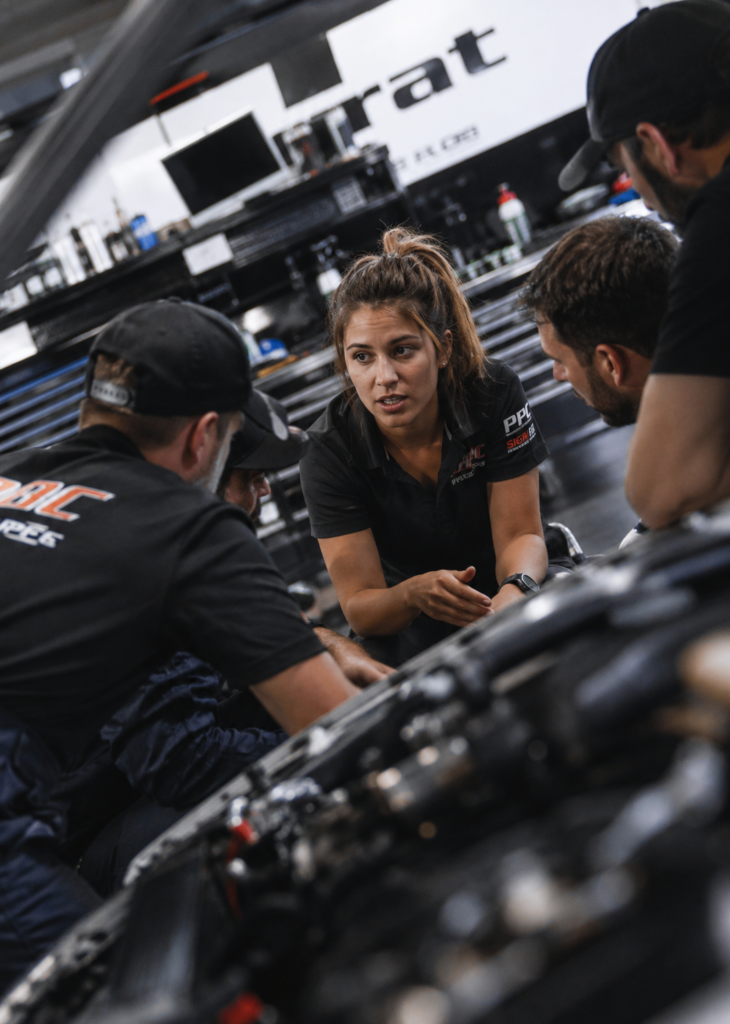
Engines fire, tools clatter, radios crackle. Teams move with the kind of urgency that comes from knowing every second matters. In those environments people tend to assume that problems will be spotted immediately. Motorsport rewards awareness. Something leaking, something loose, something sounding wrong — someone notices.
But not every problem announces itself with smoke or noise.
Sometimes the moment is social, not mechanical.
A comment lands awkwardly during a briefing. A joke draws laughter from half the room and discomfort from the other half. A junior team member gets talked over repeatedly until eventually she stops trying to contribute at all. Everyone notices something has shifted, but no one quite moves to address it. The conversation continues, the meeting wraps up, and the moment dissolves into the background of the day.
Later, if you ask people privately whether they noticed what happened, the answer is often the same.
Yes. They did.
They simply assumed someone else would deal with it.
Psychologists have been studying this pattern for more than half a century. It has a name that appears in almost every introductory textbook on human behaviour: the bystander effect. The principle is deceptively simple. The more people who witness a situation, the less likely any one individual is to intervene.
On the surface that conclusion appears counterintuitive. A larger group should mean more potential helpers. More eyes. More perspectives. More chances that someone will step forward. Yet the opposite pattern repeatedly emerges. When responsibility is shared across many observers, it tends to dissolve rather than concentrate.
The phenomenon was first demonstrated experimentally in the late 1960s by social psychologists Bibb Latané and John Darley. Their research was prompted by public debate surrounding several high-profile cases in which witnesses reportedly failed to intervene during emergencies. Rather than assuming moral failure, the researchers suspected something more subtle was occurring: a form of collective hesitation that individuals rarely recognised in themselves.
In one experiment participants sat alone in a room filling out questionnaires. Smoke began to seep slowly through a vent in the wall. When participants believed they were the only person present, most stopped what they were doing and reported the issue within minutes. When they believed several others were also completing the task in nearby rooms, reporting rates dropped dramatically. The same smoke entered the room, the same smell filled the air, but the presence of others quietly changed how individuals interpreted their own responsibility.
People began looking for cues. If no one else seemed concerned, perhaps the situation was not urgent. Perhaps someone had already reported it. Perhaps it was nothing at all.
The moment stretched.
The smoke thickened.
And still, many people continued writing.
Researchers later described several psychological processes working together in these situations. Responsibility diffuses across the group, making each individual feel less personally accountable. People read the reactions of others to determine how serious a situation might be, a process known as pluralistic ignorance. At the same time they worry about misreading the moment and embarrassing themselves by overreacting. If everyone else appears calm, speaking up suddenly feels socially risky.
The result is not indifference so much as paralysis.
Everyone is waiting for someone else to move first.
The bystander effect is often discussed in relation to emergencies — accidents, medical events, violent incidents — but the same mechanisms operate quietly in everyday environments. Offices. Classrooms. Sports teams. Workshops. Anywhere that groups of people observe the same situation and unconsciously look to each other for signals about how to respond.
Male-dominated industries introduce an additional layer to this dynamic. Hierarchies tend to be informal but powerful. Reputation matters. Loyalty matters. People build careers through networks of trust that can be difficult to challenge publicly. When uncomfortable moments arise — a dismissive comment, an off-colour joke, a pattern of exclusion — the social cost of intervening can feel significant.
It is not that people do not recognise the problem. In many cases they do.
The hesitation lies in deciding who should address it.
Women in these environments often face a particularly complex calculation. Challenging behaviour that targets their own identity risks being interpreted as oversensitivity or self-interest. Speaking up can invite scrutiny rather than support. The same intervention delivered by a colleague who is not personally affected may carry very different weight.
Research on workplace harassment and gender bias consistently finds that ally intervention — particularly from members of the dominant group — can dramatically shift how situations are perceived. When a male colleague challenges inappropriate behaviour, observers are more likely to interpret the intervention as defending shared standards rather than protecting a personal grievance. Victims report feeling more supported and more confident responding themselves when they see others step forward.
In other words, the social dynamics that suppress intervention can also amplify it.
Once someone moves, the room recalibrates.
The first voice changes how every other observer interprets the situation.
Psychologists sometimes describe this shift as norm activation. Until someone acts, the norm remains ambiguous. Silence can easily be mistaken for agreement. The moment one person intervenes, however, the group receives a new signal about what behaviour is expected.
In many cases the response that follows is almost immediate. Others nod. Someone else adds a comment. The tension breaks.
What appeared to be collective acceptance was often nothing more than collective uncertainty.
This is where the idea of the upstander emerges.
Unlike a bystander, who observes and waits, an upstander interrupts the pattern of hesitation. The action does not need to be dramatic. In fact, most effective interventions are surprisingly small. A sentence. A question. A subtle redirection that changes the tone of the interaction.
Over time many organisations have begun teaching simple mental frameworks to help people recognise these opportunities. One such model can be remembered through a single word: S.T.A.N.D.
The word itself matters. Standing implies movement. A physical shift from passive observation to deliberate presence. It captures the moment someone decides that silence is no longer the appropriate response.
Sometimes standing means speaking up, naming the behaviour in a calm and matter-of-fact way that resets the tone of the conversation. At other times it means taking care of the person affected, checking in quietly afterwards to ensure they are not left navigating the situation alone. There are moments when the most responsible choice is to alert leadership, ensuring that patterns of behaviour are documented and addressed through appropriate channels. In fast-moving environments, intervention may involve neutralising the situation entirely — redirecting attention, changing the subject, or creating an exit that defuses the moment before it escalates. And in cases where behaviour continues or becomes more serious, documentation ensures that incidents do not disappear into collective memory.
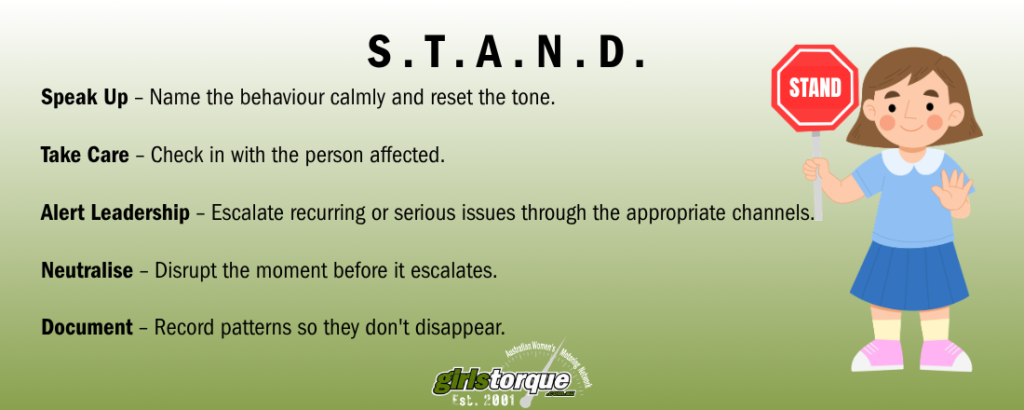 Each of these responses represents a different way of standing.
None require confrontation for its own sake. None demand perfect judgement. They simply interrupt the automatic drift toward inaction that the bystander effect produces.
The remarkable thing about intervention is how quickly it spreads.
When one person stands, others often follow. The group that appeared frozen suddenly finds its voice. A comment that might once have passed without challenge becomes the moment where expectations shift.
Culture rarely changes through grand declarations.
More often it moves through these small adjustments — the moment someone decides to move first.
In motorsport the idea is familiar. When something goes wrong on track, no one waits to see if someone else will react. The crew moves immediately. Someone grabs a fire extinguisher. Someone calls race control. Someone checks the driver. The response is instinctive because everyone understands their role.
Social environments are more ambiguous than mechanical ones, but the principle remains surprisingly similar.
The health of a team depends not only on technical skill but on the willingness of its members to act when something is off.
And sometimes that action begins with the simplest possible decision.
To stand.

Bridget Bell is a seasoned motorsport media professional and a skilled mechanic, with over a decade of experience in On-Air Hosting, Event Hosting, Television Presenting and Commentating. Passionate about supporting women in both the industry and motorsport, Bridget volunteers as a mentor and actively champions female representation.
Disclaimer: While due research has been conducted, the views expressed in our articles are those of the author and may not necessarily reflect everyone’s views. If you notice an error, please email quoting the blog article title and an explanation of the error.