

Navigating Team Dynamics, Power Balance & Personal Safety
Not all teams are safe.
Not all leaders are present.
And not all motoring environments have formal structures for escalation, feedback, or protection.
In paddocks, pits, workshops, volunteer crews, and temporary teams, people often work under intense time pressure, unclear authority, and strong informal hierarchies. The job still has to get done. The event still has to run. And when systems don’t actively protect people, individuals adapt in order to stay involved.
That adaptation is rarely acknowledged. It is often invisible, exhausting, and unevenly distributed.
This essay examines the unspoken rules people navigate in motoring environments — how power actually operates, why speaking up is harder than it sounds, and what individuals do to protect their safety and credibility when formal systems fall short. It does not frame these strategies as ideal, nor does it suggest individuals should carry responsibility for unsafe systems. It looks instead at what happens when they do.
When Risk Goes Quiet
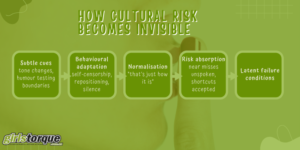
In high-pressure technical teams, cultural risk rarely announces itself loudly. It tends to surface first as subtle shifts — in how people communicate, who is included, and how mistakes are handled — long before conflict or incidents become visible.
Information begins to move sideways rather than openly. Decisions are described as “everyone knows,” yet nothing is said out loud. Small errors attract ridicule or sarcasm instead of calm correction, and near misses quietly disappear. Participation shrinks. Some people stop volunteering. Others reposition themselves — physically and socially — away from the decision makers.
Humour starts to test boundaries. Jokes about competence, toughness, or personal characteristics fail to land, but discomfort is masked to avoid standing out.
There is often a reliance on spoken lore — tribal wisdom — to define the “right way” to operate. This knowledge lives in memory rather than documentation. Only those who have been around long enough understand how to work without criticism.
Each of these behaviours is easy to dismiss in isolation. Together, they signal a shift toward silence and risk absorption — conditions under which hazards are more likely to persist.
 The Rules No One Writes Down
Alongside formal procedures, most teams operate under powerful unwritten rules. These rules are rarely stated, but they shape who belongs, who decides, and what behaviour is rewarded.
Speed is often valued over process. Calling “stop” can carry social cost. Reputation frequently outweighs role; long-standing crew members, star drivers, or senior technicians may hold more authority than the nominated supervisor. Concerns are expected to be handled quietly. Escalation is framed as disloyalty. Endurance and tolerance of discomfort are read as commitment.
People learn these rules by watching. Who is praised. Who is sidelined. Whose concerns vanish.
Those most exposed to misreading the rules are often newcomers, volunteers, contractors, women, minorities and others without strong networks or alternative pathways. The cost of getting it wrong is rarely abstract. It can mean exclusion, missed opportunities, or quiet removal from future teams.
 Power, Hierarchy, and Silence
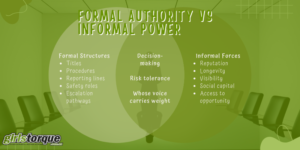
Power in motoring environments is seldom straightforward. Formal roles exist, but informal authority often carries more weight.
Licences, references, and future opportunities create pressure to self-censor. Informal status — longevity, visibility, reputation — can dominate decision-making regardless of title. In temporary teams, unclear authority leads people to default to the loudest or most confident sounding voice. Environments that prize being unflappable under pressure may treat caution or uncertainty as weakness.
Under these conditions, speaking up becomes relational rather than procedural. Whether a concern is heard depends less on what is said than on who says it.
This is why “just speak up” is often unrealistic advice. The risk is not the content of the concern. It is the potential cost of being seen as difficult, inexperienced, or disloyal.
Status Anxiety in High-Pressure Teams
These dynamics are intensified by status anxiety — the persistent worry about one’s standing, credibility, or perceived value within a group.
Alain de Botton described status anxiety as the fear of falling behind or being judged inadequate on an invisible social ladder. That ladder is often informal, unstable, and constantly shifting.
Here, status anxiety shows up quietly. People hesitate to ask questions that might signal inexperience. They comply with unsafe shortcuts to demonstrate commitment. They become hyper-vigilant about mistakes, tone, and perception. Belonging begins to feel more urgent than safety.
Over time, this erodes energy and confidence. Withdrawal follows — not because individuals lack resilience, but because the environment repeatedly asks them to prove their worth.
Status anxiety is not confined to junior or marginalised roles. It can intensify at leadership level, particularly where authority is reputation-based or shaped by rapid promotion without support. Leaders who are quietly defending their position rather than growing into it may become controlling, reactive, or resistant to emerging talent — introducing new psychosocial risks that ripple through the team, such as isolation and undermining team dynamics. This can manifest as micromanagement, emotional suppression, and reduced empathy, eroding psychological safety despite the team’s successes. Over time, such leaders push compliance over innovation, increasing turnover and burnout risks.
Navigation Without Confrontation
When systems don’t reliably protect people, individuals develop low-drama ways to reduce risk without escalating conflict. These are not ideal solutions. They are harm-reduction tools.
Concerns are framed through data, standards, or observable detail rather than personal judgement. Boundaries are tied to task outcomes — what will be compromised if something proceeds. Allies are quietly aligned in advance so highlighting issues isn’t done alone. Some people develop recognised niches — compliance, logistics, data — that lend authority to intervention.
These strategies are often mistaken for confidence or competence, when in reality they are compensations for environments that make straightforward participation unsafe — particularly for women, newcomers, and those without informal power. And while these strategies can work, they also demand extra cognitive effort. Attention is diverted from the task itself toward managing perception, timing, and reaction. Morale drops. Fatigue grows. Processes stretch.
Communication, Credibility, and Backlash
In theory, raising a concern should be straightforward. In practice, how something is said often matters as much as what is said — particularly under pressure. Here, “risk” is not limited to physical harm — it includes cultural and psychosocial conditions that shape whether people feel able to intervene before physical risk escalates.
Broad statements about something being “unsafe” can feel personal or accusatory, even when no blame is intended. Language anchored in observable detail tends to travel further. Naming what is happening — a missed check, a deviation from procedure, a change in conditions — recentres the conversation on the task rather than the person, lowering the emotional temperature without diluting urgency.
Some teams rely on short, shared phrases in these moments. A simple “Stop. Safety issue.” carries weight precisely because it is impersonal. It signals seriousness without opening a debate about competence or intent. Where these scripts exist and are used consistently, intervention feels procedural rather than confrontational.
Process-based language works in the same way. Referencing permits, checklists, or agreed standards externalises the concern, shifting it from personal judgement to collective agreement. Even questions can perform this function. Asking what risk is being accepted, or what trade-off is being made, returns responsibility to decision-makers without direct challenge.
What is often overlooked is that speaking up in these moments is not just a social act — it is a cognitive one. It requires mental bandwidth to assess risk, choose language, anticipate reaction, and absorb potential fallout. When someone is already managing task complexity, fatigue, and situational awareness, that bandwidth is finite.
This is why self-advocacy often drops precisely when it matters most. As pressure rises, emotional reactivity increases, tolerance for ambiguity shrinks, and silence or compliance can feel safer than intervention. This is not a personal failing. It is a predictable neurocognitive response to sustained pressure in environments where the cost of misjudgement feels high.
None of these approaches guarantee safety. But they can create just enough space for a concern to be heard rather than dismissed — and in high-risk environments, that margin often makes the difference.
The Personal Cost Over Time
The impact of navigating unsafe or ambiguous cultures rarely shows up as a single breaking point. It shows up as drift.
People don’t usually leave because of one comment, one incident, or one decision. They leave because sustained vigilance becomes normalised. Because managing tone, timing, and perception takes more energy than the work itself. Because doing the right thing repeatedly feels riskier than staying quiet.
Over time, this produces outcomes that are easy to misinterpret. Reduced participation is labelled disengagement. Selective involvement is read as lack of commitment. Exit is framed as poor “fit” or insufficient resilience.
What is missed is the pattern.
These are not individual failures. They are predictable responses to environments that rely on personal adaptation instead of structural protection. When capable people quietly withdraw or disappear without complaint, it is often taken as proof that the system works — when in fact it signals that it does not.
The cost is not just personal. It is organisational: lost expertise, fractured continuity, and cultures that mistake silence for stability.
 Temporary Controls Are Not the Solution
It matters how we frame these navigation strategies.
They are temporary risk controls — analogous to PPE. Sometimes necessary. Occasionally effective. Never sufficient as a primary defence.
When adaptability is praised instead of protection being designed into the system, responsibility shifts downward. The burden lands on those with the least power to change conditions.
Every workaround should raise a larger question:
Why does this person need to protect themselves this way?
What would make this strategy unnecessary?
What risks are being normalised through its routine use?
The goal is not better survival skills.
The goal should be fewer environments that require them.
Sources
-
de Botton, A. (2004). Status Anxiety. Penguin.
-
Edmondson, A. (2018). The Fearless Organization. Wiley.
-
World Health Organization (2022). Guidelines on mental health at work.
-
ISO 45003:2021 — Psychological health and safety at work.
-
BMJ Leader (2021). Psychological safety and incident reporting systems.
-
Frontiers in Public Health (2024). Psychological safety, leadership, and safety outcomes.
-
British Psychological Society. Status anxiety at work.

Bridget Bell is a seasoned motorsport media professional and a skilled mechanic, with over a decade of experience in On-Air Hosting, Event Hosting, Television Presenting and Commentating. Passionate about supporting women in both the industry and motorsport, Bridget volunteers as a mentor and actively champions female representation.
Disclaimer: While due research has been conducted, the views expressed in our articles are those of the author and may not necessarily reflect everyone’s views. If you notice an error, please email quoting the blog article title and an explanation of the error.