

Four Women, Four Perspectives
The 2026 Australian Grand Prix in Melbourne offered more than a showcase of speed and spectacle. Across the weekend, it provided a clear view into how engineering actually operates in motorsport — not as a single discipline, but as a progression.
From early engagement and education, through to cross-industry thinking, and into the technical detail of modern Formula One systems, engineering revealed itself in layers. Each perspective contributes to an understanding of how capability is built, applied, and refined at the highest level of performance.
This is not a recap of the event.
It’s four engineering perspectives — each capturing a different point along that pathway.
The Spark: Engineering as a Starting Point
Selini Samaranayake
This was a significant weekend not only for Engineers Australia, but for motorsport as a whole. With International Women’s Day falling on the Sunday and the Innovation Hub launching on the Thursday, the timing created a strong platform to highlight the role engineering plays in the sport.
As part of the Student Ambassador team for Engineers Australia, Selini Samaranayake worked across the booth supporting the National Science and Engineering Challenge — an activation designed to bring aerodynamics to life in a practical, accessible way.
Participants were invited to design a rear wing by repositioning magnets to alter aerodynamic behaviour. These designs were then tested in real time using a 3D-printed model and a controlled airflow system. The outcome was immediate and visible: a direct link between design decisions and performance.
What stood out was not just participation, but engagement.

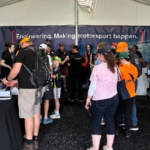
Selini focused on creating a space where participants could think, test, and refine their ideas. Asking individuals to predict outcomes, explain their reasoning, and iterate on their designs introduced a core engineering principle early: improvement through repetition and reflection.
It became less about getting the “right” answer and more about understanding the process.
The booth drew in both parents and children, opening conversations about engineering pathways from a young age. Early exposure plays a critical role in maintaining interest in STEM, particularly for girls, and moments like this help bridge the gap between curiosity and career consideration.
The long-term impact is difficult to measure in real time, but the intent is clear — to create a lasting impression strong enough that those early interactions translate into future engineers.
The Shift: Seeing Engineering Differently
Devyani Pal
Her passion for engineering began early, attending air shows and being fascinated by how machines that seemed impossible could actually fly.
Being at the Formula 1 event brought that same feeling back — but this time through the lens of someone studying engineering.
Instead of simply watching the cars pass, Devyani found herself thinking about everything behind the scenes: the aerodynamics shaping airflow, the thermal systems managing extreme temperatures, and the structural design that allows the cars to be both incredibly light and incredibly strong.
What stood out most was how visible the engineering process becomes in Formula 1.
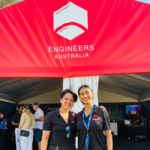
With performance measured in milliseconds, every design decision matters. Small adjustments in setup, airflow, or tyre strategy can change the outcome of a race, highlighting the precision and constant optimisation required at this level.
Observing how teams analyse data, communicate trackside, and iterate in real time reinforced that engineering in this environment is not just about designing components — it is about problem-solving under pressure.
The experience reaffirmed why Devyani chose to pursue engineering.
It demonstrated how multiple disciplines — aerodynamics, mechanical design, materials, and data analysis — come together to push the limits of what is possible. Seeing that environment firsthand was both motivating and a reminder that engineering is ultimately about turning complex ideas into high-performance systems in the real world.
The Mindset: Engineering Across Industries
Jasmin Diab
“I love engineering at 300 km/h.”
Walking through the paddock at the 2026 Australian Grand Prix, the atmosphere extended beyond the sound of hybrid power units and into something more deliberate — a recognition of the growing presence of women in engineering.
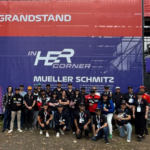
Coinciding with International Women’s Day, Formula One and Engineers Australia highlighted women across the industry through the In Her Corner initiative. Engineers, strategists, technicians, and leaders were recognised not as exceptions, but as part of a broader shift within the sport.
For Jasmin Diab, a nuclear engineer, the experience resonated well beyond motorsport.
At first glance, Formula One and nuclear engineering appear fundamentally different. One operates on the edge of performance, measured in milliseconds. The other is defined by long-term operation, safety, and regulation over decades.
However, the underlying engineering philosophy is closely aligned.
Both environments operate under strict regulatory frameworks. Every decision must balance performance, compliance, reliability, and safety. Innovation is not achieved by bypassing constraints, but by understanding and working within them.
Precision defines both industries.


In nuclear engineering, systems are designed to operate flawlessly over long time horizons, with extensive verification and validation processes. In Formula One, components are subjected to extreme loads, temperatures, and speeds, yet are expected to perform with equal reliability — just within a vastly compressed timeframe.
What might take months of modelling and approval in one industry is executed in seconds in the other.
This contrast became particularly clear during a practice session incident involving Mercedes rookie Kimi Antonelli. Following a significant crash, the team had just two hours to rebuild the car ahead of qualifying.
Within that window, engineers and mechanics replaced damaged components, recalibrated systems, and verified structural integrity.
In that same two-hour window, I had two Heineken Zeros and fed my baby — while the team effectively rebuilt a Formula One car.
The process was rapid, but not rushed — grounded in preparation, defined roles, and engineering discipline.
Mic drop from the engineers.
Every action is deliberate. Every system is understood. Every decision is informed.
Across both motorsport and nuclear engineering, the same principle applies: continuous improvement. Whether refining lap time or strengthening system resilience, the objective remains consistent — better, safer, more reliable outcomes.
The environment may differ, but the mindset does not.
The System: Understanding Deceleration in Modern Formula One
Blossom Fernandez
During observation of cars decelerating into Turn 6, a short, sharp mechanical sound became apparent as drivers braked and downshifted at lower speeds. The sound was most noticeable late in the braking phase and did not align with typical exhaust or turbocharger noise characteristics.
This prompted further investigation into the mechanisms involved in deceleration under current FIA powertrain regulations.
Modern Formula One deceleration is achieved through a combination of systems: hydraulic braking, regenerative braking via the Motor Generator Unit–Kinetic (MGU-K), and controlled downshifts through a constant-mesh sequential gearbox. Traditional engine braking is limited by fuel flow and ignition regulations, reducing the contribution of combustion-related effects during corner entry.
As a result, the deceleration process shifts toward mechanical and hybrid system interaction.

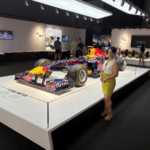



The observed sound does not appear to originate from a single source, but rather from a combination of events occurring simultaneously. At lower vehicle speeds, reduced aerodynamic and exhaust noise allows underlying mechanical processes to become more audible.
The timing of the sound, closely aligned with downshift events rather than initial brake application, suggests gearbox and hybrid system activity as primary contributors.
Gearbox Engagement
Formula One gearboxes utilise constant-mesh, dog-engagement systems. During rapid downshifts, dog rings engage quickly, producing short-duration mechanical impulses. These impulses can transmit through the gearbox casing, particularly when external noise levels are low.
Hybrid Torque Transitions
During deceleration, the MGU-K transitions between regenerative and neutral torque states. These rapid torque changes can introduce brief mechanical or electromechanical noise, contributing to the overall sound profile observed trackside.
Turbocharger Speed Decay
As throttle input reduces, exhaust energy decreases and turbocharger speed drops. While not identified as the dominant source, these transient changes may contribute subtle acoustic elements within the broader system response.
Structural Sound Transmission
The gearbox casing acts as a structural member with relatively low acoustic damping. This allows internal mechanical activity to transmit outward, making events such as gear engagement more perceptible under low-noise conditions.
Across the weekend, engineering presented itself not as a single role or discipline, but as a progression.
It begins with exposure — creating opportunities for curiosity and engagement.
It develops through mindset — applying consistent principles across different industries and environments.
It culminates in execution — where systems, precision, and performance converge under pressure.
Motorsport provides a unique lens through which this progression can be observed in real time.
From the first interaction at a hands-on activation, to the shared philosophies across engineering fields, and into the detailed behaviour of high-performance systems, each stage contributes to a broader understanding of what engineering is — and what it demands.
The pathway is not linear, but it is connected.
And increasingly, it’s not just visible — it’s accessible.


Blossom Fernandez is an automotive engineer specialising in electric vehicle systems and standards. She contributes to EV standards committees and supports emerging engineers through mentoring and STEM engagement. Blossom is a relentless learner committed to growth, challenge, and constant evolution.