

— She’s Efficient
The workshop was full of tension and fluorescent light. Senior leadership had flown in, HR in tow, to talk wages. They kept using the word “tickle” when describing their intentions to adjust our pay in line with the market value.
The crew made their cases. Spoke up. Debated for an hour. Eventually, the leader asked, “Any final questions?”
The team looked at me.
I assured them, “The number will be right. That’s why toolboxes have wheels.”
Silence. HR blinked like they’d licked a battery. My crew? You could see the pride shift in their shoulders. By morning tea, each of them had found a reason to check in and quietly say thanks.
The company found the money. Restructured the work week for better work/life balance. Staff stayed. Productivity improved.
Nobody raised their voice. Nobody had to.
But that story doesn’t always play out so cleanly. Especially when your job changes, and the uniform gets traded for a name badge. One day you’re leading from the floor, and the next, you’re being asked to lead from the desk—where the rules shift, but nobody hands you the new operating manual. It’s assumed you know what to do.
In the workshop, you’re clear because time matters. Safety matters. Jobs get done when communication is short, sharp, and unambiguous. That style isn’t rude; it’s efficient. You learn how to speak in ways that protect the team, not egos. You learn how to keep a job moving, not a conversation flowing.
But in the office? That same tone gets labelled as abrasive. Your refusal to pad every sentence in soft disclaimers—qualifiers like “just,” “if it’s okay,” “maybe,” or “I was wondering if…”—is suddenly a problem. You didn’t change. The room did.
Even the way you stand can feel out of place. On the tools, presence matters—shoulders squared, stance solid, chin up. In the office, that posture reads as dominant. Confronting. Too confident. Especially to those coasting in the comfort of mediocrity.
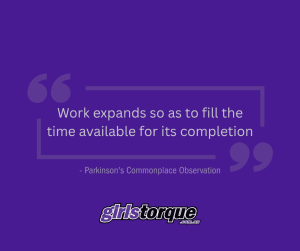
In another job, I watched a colleague stretch a five-minute parts-receiving task into a full-blown performance, Parkinson’s Commonplace Observation on display. I took over, sorted it, and moved on. Later, I got pulled aside. Someone had reported me for being bossy. I cried, then I laughed. I’d been grafting overtime to prove I was worth the hire, only to be punished for efficiency. When I got the full story, I told my mentor the truth: being labelled ‘bossy’ is a mediocre man’s way of covering for his own inadequacies.
The double standard is real.
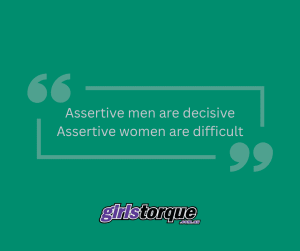

We’re judged not on what we say, but on whether we say it with a smile. The expectation isn’t professionalism—it’s palatability. And it starts to grind your gears.
Women are often expected to carry emotional labour—the work behind the work. Arlie Hochschild summarised it in her book The Managed Heart: Commercialization of Human Feeling (1983) “Emotional labor is the management of feeling to create a publicly observable facial and bodily display; emotional labor is sold for a wage and therefore has exchange value.” Offices don’t just want your labour. They want your tone. Your smiles. Your strategically delayed opinions. You’re not just expected to communicate. You’re expected to cushion.
People assume that women in trades are performing masculinity to fit in. They’re not. They’re fluent in the communication style that their environment demands. They didn’t fake it to survive. They do it without losing who they are. Judith Butler in Gender Trouble (1990) said, “Gender is in no way a stable identity or locus of agency from which various acts proceed; rather, it is an identity tenuously constituted in time—an identity instituted through a stylised repetition of acts.” So when that same woman steps into an office and speaks the way she always has—with clarity, confidence, and a little grit—it throws people. Not because she’s wrong. But because she’s unexpected.
I’ve watched rooms shrug off a woman’s great idea until I ask the only question that matters: “But… is she wrong?”
The eye-rolls stop. People suddenly remember how to think. It still amazes me how quickly competence changes depending on the mouth it comes from.
And here’s the truth: it’s not you. It’s them. But it is your job to contextualise. That doesn’t mean change. That means knowing which room you’re in—and holding your ground effectively. You can speak directly and still lead—when the message is clear, being concise gets the job done. But sometimes it’s worth taking the long way around. Not to perform, but to show empathy. Softening your tone doesn’t blunt your skill—it builds connection. And you can demand excellence without needing to perform femininity just to make others comfortable. That kind of awareness—of when to hold, when to soften, when to lead—can be the difference between fitting in and reshaping the room around you.
Maybe the business chose change. Maybe it was just time. Maybe it was budget, or structure, or convenience. Either way, you were the best candidate for the job—and your presence alone has the power to shift the culture. The right hire can elevate a workplace. The wrong one can rot it from the inside out. Sometimes, just existing in the space is enough to sage the room, to smoke out the ego and expose the inefficiencies. But that same presence, unchecked, can just as easily tip the balance the wrong way. This isn’t about changing who you are. It’s about metering your delivery—bringing all your determination and experience, but learning when to hold, when to lead, and when to let people figure it out for themselves.
You don’t have to water yourself down to survive it. But you do have to learn the new rhythm. You have to contextualise. You have to pick your moments, find your allies, and sometimes choose your words like you choose your tools: based on the job at hand.
“Things turn out best for the people who make the best of the way things turn out.” —John Wooden
You’ve already proved yourself in places where mistakes don’t just affect the team—they can ripple out to the operator, the consumer, the end user. Where cutting a corner, straying from the process, or offering up unsolicited initiative isn’t just inefficient—it can be dangerous. The work you’ve done has carried real weight, with consequences that extend far beyond your own hands. You know what it means to earn respect one job at a time. Now, the measure has shifted. It’s not about whether you fit in. It’s about whether you can bring the best of what you know into a room that wasn’t built for you—and still make a contribution.
To the woman who’s just stepped off the tools and into the office: you belong here. But like any new site, it will take a minute to learn the terrain.
You are not too much. You are not too blunt. You are not bossy.
You are capable. You are adaptable. You are needed.
And it’s okay if the fit isn’t perfect yet. The room is still adjusting to you, too.

Bridget Bell is a seasoned motorsport media professional and a skilled mechanic, with over a decade of experience in On-Air Hosting, Event Hosting, Television Presenting and Commentating. Passionate about supporting women in both the industry and motorsport, Bridget volunteers as a mentor and actively champions female representation.
Disclaimer: While due research has been conducted, the views expressed in our articles are those of the author and may not necessarily reflect everyone’s views. If you notice an error, please email quoting the blog article title and an explanation of the error.