

From Cricket Pitches to Quarter Miles
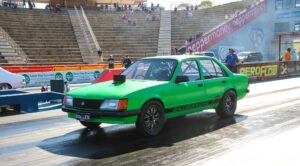
The staging lanes at Sydney Dragway hum with a kind of nervous electricity. Engines idle, tyres squeal, and racers steel themselves for the light to flicker green. At the centre of it all, a deep-green VH Commodore sits low and purposeful, its driver helmeted, harnesses tight. Inside, Sammy-Jo “SJ” Johnson waits — measured, calm, and fiercely ready. It’s a scene that feels worlds apart from the white-flannel cricket ovals and roaring stadiums where she built her name. And yet, for Johnson, it’s all one story: the pursuit of excellence, resilience under pressure, and the unwavering belief that if you turn up, put in the work, and love what you do, the rest will follow.

A Life Built on Sport
Sport has been Johnson’s compass since childhood. Growing up in Lismore, New South Wales, she was the only girl in a boys’ cricket team — a detail that seemed unremarkable to her at the time. “I didn’t even know the Australian Women’s cricket team existed,” she admits. By age 17 she had a scholarship to play in England, juggling Year 12 study with a six-month stint overseas. It was a gamble, but one that paid off spectacularly, setting her up for what would become a 15-year career in elite cricket.
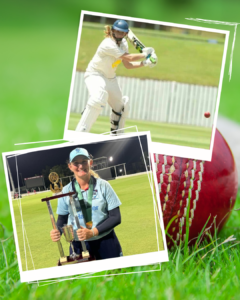
Her résumé is formidable: ten years in Queensland, five seasons with the Brisbane Heat, a return to Sydney with the Thunder and Breakers, and three WBBL titles — a feat no one else has matched. “That’s the one thing no one can take away from me,” she says with quiet pride. In an era when women’s cricket was exploding onto the global stage, Johnson was both a witness and a contributor, traveling through India and England, and proving herself not just as a fast bowler, but as a leader. She even captained the New South Wales Breakers, breaking the old stereotype that pace bowlers couldn’t lead.
But woven into the triumphs were bruising setbacks. Johnson knows what it is to be dropped, sometimes for performance, sometimes for politics. She knows the sting of being sidelined after only two games as captain. “It was really hard,” she recalls. “But I just turned up the next day, ran drinks, and made sure I was the best thirteenth player I could be.” Those lessons — to accept disappointment without internalising it, to focus on the controllables, to keep showing up — became a kind of armour.
A New Chapter on the Drag Strip
It was a different kind of strip that pulled Johnson into her next sporting obsession. At seventeen, long before her cricketing career had peaked, she rolled her car into a council-run eighth-mile meet on an old airstrip. There she met Sue Corbett — a pioneer and advocate for women in motorsport, whose encouragement left a lasting mark. “Sue made me feel welcome straight away,” Johnson recalls. “She was so calming, so genuine. After that day, I knew I wanted more.”
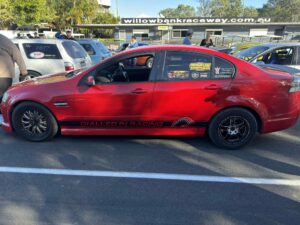
The moment feels almost mythic now — Johnson’s first drag race overlapping with the early days of Girls Torque, Corbett’s passion project to bring more women into the sport. Nearly two decades later, Johnson is back on the same stage, this time as a competitor whose name is starting to resonate in the Super Street bracket.
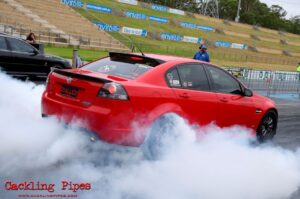
Her current machine is a 1981 VH Commodore, rebuilt with the help of her race team, Dialled In Racing, after her previous car’s engine gave out. The new build was a mad sprint: six weeks of evenings and weekends, a Frankenstein of parts and teamwork that now runs a best of 10.60 seconds at 126mph. Bracket racing, where competitors nominate a “dial-in” time and then try to run as close as possible without breaking out, is a ruthless game of margins. Reaction time is everything. “In Sydney, most racers cut under 0.050 seconds. It’s ridiculously competitive,” Johnson explains.
For her, the appeal isn’t raw horsepower, but precision. “Everyone wants big numbers on the screen. But for us, it’s about consistency, about running your number again and again.” It’s the same mindset she honed in cricket: preparation, repetition, discipline. It’s why she’s at Sydney Dragway every Wednesday night for Aeroflow’s Race 4 Real meets, practicing when others are resting.
The Mental Game
If cricket taught her resilience, drag racing sharpened it. In both sports, setbacks are inevitable. She tells the story of a recent street shootout where she was the only woman in a field of 106, and the slowest car among a sea of eight- and nine-second monsters. The VH was unsettled, tyres spinning, nothing felt right. Yet Johnson clawed her way through eliminations, even winning a semifinal bye via a game of rock-paper-scissors. In the final, under the weight of expectation, she jumped the start. Disqualified instantly.
“You have two options in that moment,” she says. “Kick your gear around, sulk, blame everyone else. Or you treat it as a learning curve. We had a positive day, we took a lot of experience from it.”
It’s this philosophy that underpins her voice in Girls Torque’s Mental Health Month campaign. She knows how corrosive it can be to tie your worth to performance. She’s seen athletes unravel under pressure, or lose themselves when a contract ends. Her antidote is consistency, humility, and the courage to start small. “If I start too big too soon, I’ll never get there. I’ve got to chase the little wins first.”
Her words land with a gravitas that only comes from lived experience. “You’re gonna lose games. You’re gonna lose races. But you’ve got to keep perspective. Focus on what you can control. Give them no reason to drop you next time.”
A Second Family
If cricket was her first family, drag racing has become her second. Her partner Brian, who once sacrificed his own season by giving her his engine, is ever-present. Dialled In Racing — Brett, Sharon, and their sons Aidan and Corey — have wrapped her into their fold with the kind of support that feels life-changing. Her mother and sister are fixtures at the track, volunteering alongside her when she’s not racing, ferrying parts, watching from the grandstands. Sponsors like Raffia Scaffolding, Shift Right, Aeroflow Performance, Diff Technics, and PSC Racing round out the village that keeps her dream alive.
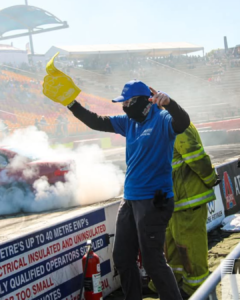
Johnson herself gives back in kind. As a volunteer official at Sydney Dragway, she’s staged cars, handed out time cards, even cleaned up after burnouts. She relishes the sense of belonging, the shared responsibility of making race day safe and seamless. “It’s a team, a family environment,” she says simply.
Beyond the Finish Line
For all her achievements — top-ten finishes, number one qualifiers, second place in the 2025 NSW Super Street standings — Johnson insists she’s still a rookie. Her goals are bold: number one in NSW, number one in Australia, maybe even a tilt in America. But behind the ambition is something quieter and more enduring.
The car itself — the green Commodore, self-built and deeply personal — is her refuge. “That car is a saving grace for me,” she says. “It represents who I am. On bad days, at work or at home, I can get in that car, and I know I built it with my family and friends. That means everything.”
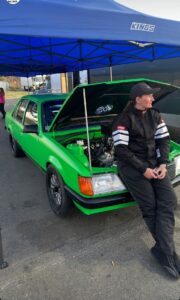
It’s a sentiment that transcends sport. For Johnson, cars aren’t just machines. They’re vessels for confidence, for independence, for community. They’re proof that passion, when coupled with resilience, can carry you from one chapter of life to the next.
As she lines up again under the lights, engine vibrating through the harness, she is both the girl from Lismore who bowled to boys and the woman who practices every Wednesday because “the only way you get better is by practicing.” Cricket may have given her the armour, but drag racing has given her a home. And in both, Sammy-Jo Johnson has found her voice.


Maddi Gurmesevic is an aspiring writer and journalist within the automotive and Motorsport world. She has a large passion for the sport itself, as well as sharing the incredible stories of people across different facets of the industry. Maddi is also a driver herself, competing in Karting since an early teen, along with volunteer work with Motorsport Australia.