

How Motorsport Engineers Design Things That Break
Engineering has a public relations problem.
Ask someone what engineers do and the answers are remarkably consistent. They build bridges that don’t collapse. Buildings that remain standing. Aircraft that stay in the sky. Race cars that survive enormous mechanical and aerodynamic loads. The profession is generally understood as a pursuit of strength, reliability and permanence.
Failure, by comparison, is usually treated as evidence that something has gone wrong.
Yet spend enough time speaking with structural engineers and a more complicated picture begins to emerge. The goal is rarely to eliminate failure altogether. More often, the challenge is understanding how failure occurs and controlling it when it inevitably does.
That distinction sits at the centre of motorsport infrastructure.
When structural engineer Dan Cook describes his work, he doesn’t begin with barriers or catch fencing. He begins with uncertainty.
Most structures, he explains, operate within relatively well-understood conditions. Engineers can determine wind loads, occupancy requirements, earthquake actions and a host of other environmental factors using established standards and decades of accumulated knowledge. While every project presents its own challenges, the fundamental behaviour of the structure is usually predictable.
Motorsport occupies a less comfortable space.
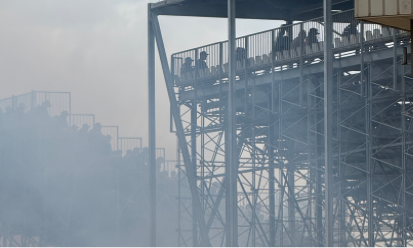
A grandstand, for example, must still satisfy the conventional requirements of structural design. It must withstand wind. It must safely support occupants. It must remain serviceable throughout its intended life. Yet unlike most buildings, it is also expected to accommodate large crowds moving collectively through the structure. Those movements can generate rhythmic vibrations that become a design consideration in their own right. At the same time, spectators expect uninterrupted views of the circuit, encouraging long spans and cantilevered arrangements that create substantial structural demands.
Then there are the things that cannot be defined quite so neatly.
Vehicle impacts.
Debris.
Unexpected interactions between machines travelling at speed.
A building is unlikely to experience a Formula Ford one weekend and a Top Fuel dragster the next. A race circuit might.
It is perhaps unsurprising, then, that Cook repeatedly returns to the limits of prediction. When discussing crash events and debris impacts, he notes that the variables become difficult to quantify. Vehicle mass, speed, impact angle, aerodynamic behaviour and debris trajectories all influence the outcome. Standard building codes offer limited guidance for such scenarios because they were never intended to address them.
The response is not to abandon analysis, but to supplement it.
Crash-tested systems, validated performance criteria and full-scale testing become essential tools because some questions are ultimately answered more convincingly by observation than calculation.
This becomes particularly apparent when discussing motorsport barriers.
There is a natural tendency to assume that safety improves as structures become stronger. Strength is intuitive. Strength feels reassuring. Yet motorsport barriers are not simply required to resist loads. They must manage energy.
The distinction matters.
A rigid wall can stop a vehicle. So can a cliff face.
Neither outcome would necessarily be considered successful.
Cook draws a useful distinction between conventional protective structures and motorsport safety systems. Traditional engineering solutions often seek additional strength and stiffness, comfortably exceeding anticipated loads. Motorsport barriers operate according to a different philosophy. They are expected to deform.
Not because they are inadequate.
Because they are functioning exactly as intended.
The barrier’s purpose extends beyond protecting whatever lies behind it. It must also protect the driver. Energy absorbed through controlled deformation is energy that does not return to the vehicle and its occupant. Dynamic behaviour becomes more important than static strength. The materials, the geometry, the anchorage and even the available clearance behind the barrier all contribute to performance.
It is a curious inversion of what many people imagine engineering to be.
The safest system is not necessarily the one that moves the least.
The same observation appears elsewhere in motorsport infrastructure. Consider the temporary structures that populate paddocks, pit areas and event precincts around the world. Temporary construction often carries an implicit suggestion of impermanence, as though the engineering standards might somehow be lower than those applied to permanent facilities.
Cook’s description suggests the opposite.
A temporary pit structure must still resist the loads expected of any comparable building. The difference is that it must do so while also surviving repeated transport, assembly, dismantling and storage. Each cycle introduces opportunities for damage, wear and degradation. Anchorage systems may change from venue to venue. One site may provide dedicated tie-down points while another requires ballast systems or alternative restraint methods.
The structure itself is only part of the engineering challenge.
Inspection becomes equally important.
This is perhaps one of the quieter themes running through motorsport engineering. The public imagination tends to focus on design. Engineers, however, often spend considerable time thinking about condition. Components age. Connections loosen. Materials deteriorate. Temporary works move from location to location. Confidence in a structure depends not only on how it was designed, but on knowing how it has been treated since.
The conversation becomes even more interesting when applied to testing facilities.
Cook notes that the purpose of a dyno cell or structural test rig is to measure the behaviour of the test article, not the supporting structure. Consequently, the foundations and mounting systems must be sufficiently stiff that their own movement does not contaminate the results. In this context, stiffness becomes valuable not because movement is dangerous, but because movement obscures the truth.
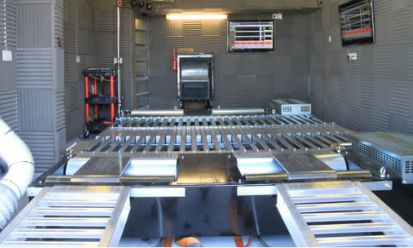
The structure succeeds by disappearing.
Asked how structural engineers account for unpredictable loads, Cook’s answer is notably brief.
“Robustness and redundancy.”
Engineers often possess a talent for condensing complex ideas into deceptively simple language.
Robustness acknowledges that unexpected events occur. Redundancy acknowledges that individual elements can fail. Neither concept promises perfection. Instead, both accept uncertainty as a fundamental characteristic of the real world and seek to limit its consequences.
There is a certain pragmatism in that approach.
Engineering is frequently portrayed as a discipline concerned with precision, and it is. Yet precision alone is insufficient when confronting systems that must function amid incomplete information and unpredictable events. The challenge is not merely determining how a structure should behave under ideal circumstances, but understanding how it will respond when circumstances cease to be ideal.
That reality becomes particularly apparent at circuits hosting multiple categories of racing. A safety system that performs effectively for one class of vehicle may experience very different loading conditions when confronted with another. Street circuits introduce further complexity, relying heavily on temporary works to achieve safety outcomes comparable to permanent facilities. Even relatively minor decisions—such as placing equipment, signage or temporary structures behind a barrier—can influence how that barrier performs by reducing the space available for controlled deflection.
None of this is especially visible to spectators.
If a catch fence performs correctly, most people never think about it again. If a barrier absorbs an impact as intended, attention quickly returns to the race itself. If a grandstand remains stable beneath thousands of spectators, nobody leaves the circuit discussing the structural calculations.
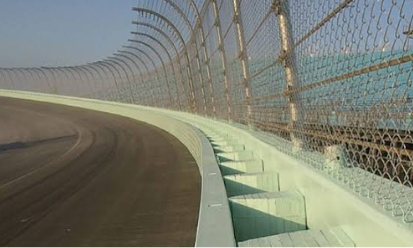
Success is largely invisible.
Perhaps that is why motorsport structural engineering receives less attention than the vehicles it supports. The work exists in the background, quietly creating the conditions that allow everything else to happen safely.
Yet there is something profoundly interesting about a discipline that spends so much of its time considering uncertainty.
Not how to eliminate it.
How to live with it.
And perhaps that is the real answer to the question posed by this article’s title.
Motorsport engineers do not design things to break because they expect failure.
They design them to break because they understand that the world is more complicated than strength alone.


Blossom Fernandez is an automotive engineer specialising in electric vehicle systems and standards. She contributes to EV standards committees and supports emerging engineers through mentoring and STEM engagement. Blossom is a relentless learner committed to growth, challenge, and constant evolution.