

What Changed, What Didn’t
We went back and re-read the reports.
Not because they’re new. The original Respect@Work inquiry landed in 2020. In the time since, Western Australia produced its own response through Enough is Enough, followed by a 2025 progress report that closes the loop on what was identified and what has been implemented.
On paper, it reads as a five-year cycle — problem, response, integration.
Six years is enough time to put systems in place — and start assuming the problem outlined in the 2020 report has been handled.
To understand what that actually means, you have to look at it retrospectively — not as a standalone set of documents, but as part of a longer pattern across Australian workplaces. For those who have been in the workforce across that period, the shift — or lack of it — will be familiar.
Australia has had legislative frameworks around workplace equality since the 1980s, anchored by the Sex Discrimination Act 1984. On paper, the country was early, structured, and in many ways ahead of the curve in how these issues were defined and regulated. By 2020, it was clear that what existed on paper was not translating cleanly into practice.
The Respect@Work inquiry did not describe a fringe issue. It described something widespread, under-reported, and structurally enabled — not only by individual behaviour, but by the environments in which that behaviour occurred. Workplaces where hierarchy, access to opportunity, and reputation intersect in ways that make speaking up a calculated risk.
Which shifts the conversation away from isolated behaviour and toward structure — how workplaces are built, how access is controlled, and how risk is distributed.
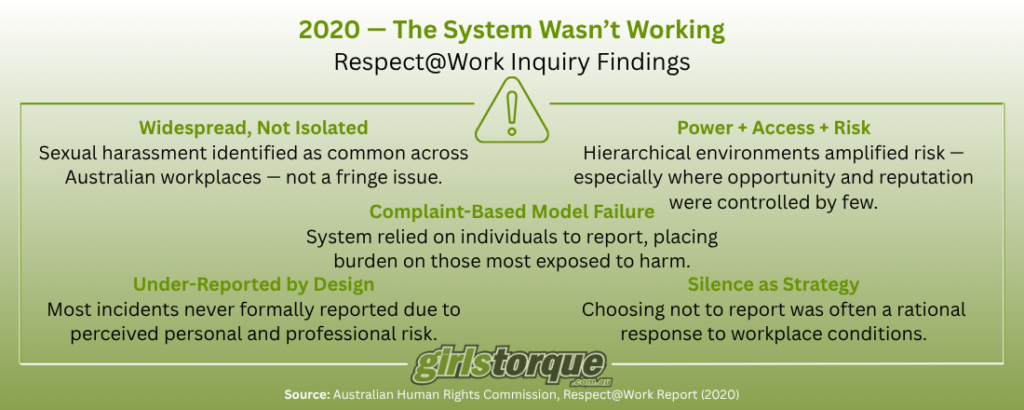
As recently as 2020, the system relied heavily on complaints. The mechanism was straightforward: behaviour occurs, an individual reports it, and the organisation responds.
In practice, that model consistently failed. Not because individuals were unable to recognise inappropriate conduct, but because they understood the conditions around them. When reporting carries potential cost — social exclusion, loss of opportunity, and reputational damage — silence functions as a rational response to the environment rather than a personal shortcoming.
This reflects a failure in system design rather than culture alone.
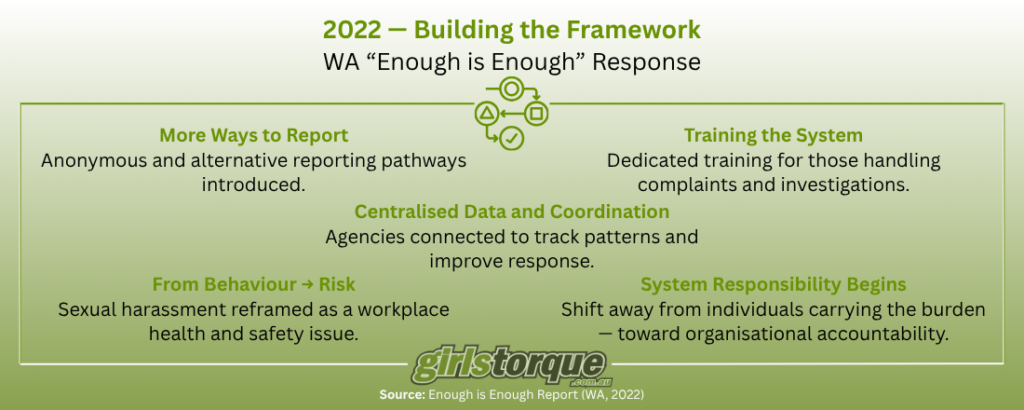
By 2022, Western Australia’s response begins to take shape, and the tone shifts from diagnosis to construction. Enough is Enough reads less like awareness and more like system design. Reporting pathways are expanded, including anonymous options. Data collection is centralised. Agencies are coordinated. Training is introduced for those receiving complaints, and guidance materials and codes of practice are developed.
More significantly, sexual harassment is reframed within a work health and safety context, positioned as a psychosocial hazard rather than an interpersonal issue.
This reframing shifts responsibility from the individual to the system, requiring that risk be identified, managed, and prevented as part of standard workplace operations.
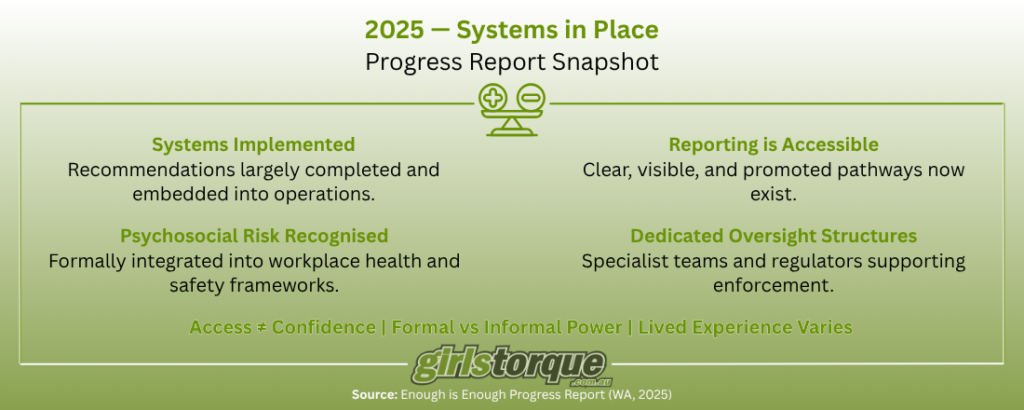
By 2025, the language shifts again. The progress report is no longer framed in terms of intent or direction, but in terms of completion. Recommendations are marked as implemented. Systems are described as integrated into standard business practice. Reporting mechanisms exist, are accessible, and are actively promoted. WorkSafe operates as a central coordinating body, supported by specialised teams and cross-agency data sharing, and psychosocial risk is embedded within regulatory frameworks.
From a structural perspective, the system that was absent in 2020 now exists in full. That shift is material. However, the reports are less definitive on how these systems are experienced in practice. While access to reporting has improved, there is less clarity on whether confidence in using those systems has improved at the same rate. A reporting pathway can be anonymous, available, and well-publicised, while still existing within an environment where the perceived cost of using it remains high.
The variables identified in 2020 have not been eliminated. Power remains unevenly distributed, access to opportunity is still controlled, and reputation continues to move through networks — usually ahead of anything written down.
In industries built on tight networks and repeat engagement, professional conduct does not operate independently from social consequence. These conditions do not negate the system that has been built, but they shape how it is navigated.
Across the three reports, there is a clear attempt to shift responsibility away from the individual and toward the organisation. The introduction of a positive duty — an expectation that workplaces actively prevent sexual harassment rather than respond to it after the fact — represents a significant structural correction.
However, the impact of that duty is not determined by how it is written, but by how it is experienced. A requirement can exist formally without being consistently realised in day-to-day decision-making, particularly in environments where performance, access, and reputation remain central.
Although the later reports focus on mining, the mechanics they describe are not unique to that sector. Male-dominated workforces, hierarchical progression, contracting layers, reputation-based access, and blurred professional and social boundaries are recognisable across a range of industries, including automotive and motorsport.
Between 2020 and 2025, the system has matured. It now has language, process, and regulatory backing. It can define the issue, provide pathways to report it, and establish expectations for how it should be managed. What is less visible is how consistently those structures hold when tested in real conditions — when reporting intersects with opportunity, when hierarchy is not abstract, when relationships are close, and when consequences are not theoretical. Systems are not tested at the point of design, but at the point of friction.
At this stage, the question is no longer whether the issue exists, or whether a framework has been built around it. The question is how people operate within that framework, particularly in environments where informal influence continues to carry weight.
Not only what is formally prohibited, but what is informally tolerated.
Not only what is reported, but what is absorbed, normalised, or quietly navigated.
The reports map the system, what they do not fully capture is the lived interface with it. That is where we must go next.
Sources:

Respect@Work: Sexual Harassment National Inquiry Report — Australian Human Rights Commission

Enough is Enough: Sexual Harassment Against Women in the FIFO Mining Industry — Government of Western Australia

Enough is Enough – Final Progress Report — WorkSafe Western Australia

Bridget Bell is a seasoned motorsport media professional and a skilled mechanic, with over a decade of experience in On-Air Hosting, Event Hosting, Television Presenting and Commentating. Passionate about supporting women in both the industry and motorsport, Bridget volunteers as a mentor and actively champions female representation.
Disclaimer: While due research has been conducted, the views expressed in our articles are those of the author and may not necessarily reflect everyone’s views. If you notice an error, please email quoting the blog article title and an explanation of the error.