

Learning the Lanes
At Portland, race day doesn’t arrive all at once — it unfolds steadily.
The strip glistens in the morning sun, inviting the racers to the finish line. Pine trees hem the facility like sentinels, lining the edge of the staging lanes where junior dragsters wait for their round. The pits sit on expanses of grass, giving teams room to work and kids room to move.
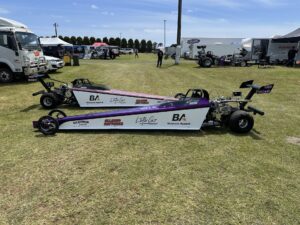
Near the start line, shade sails cover the spectator area above a grassy hillock, beside the clubrooms and stands. A modest timing tower sits opposite, between the start line and the burnout pad, positioned for clear visibility of the start line and an uninterrupted view of the finish.
This is South Coast Raceway on race day: regional, measured, and built for racing that rewards patience as much as pace.
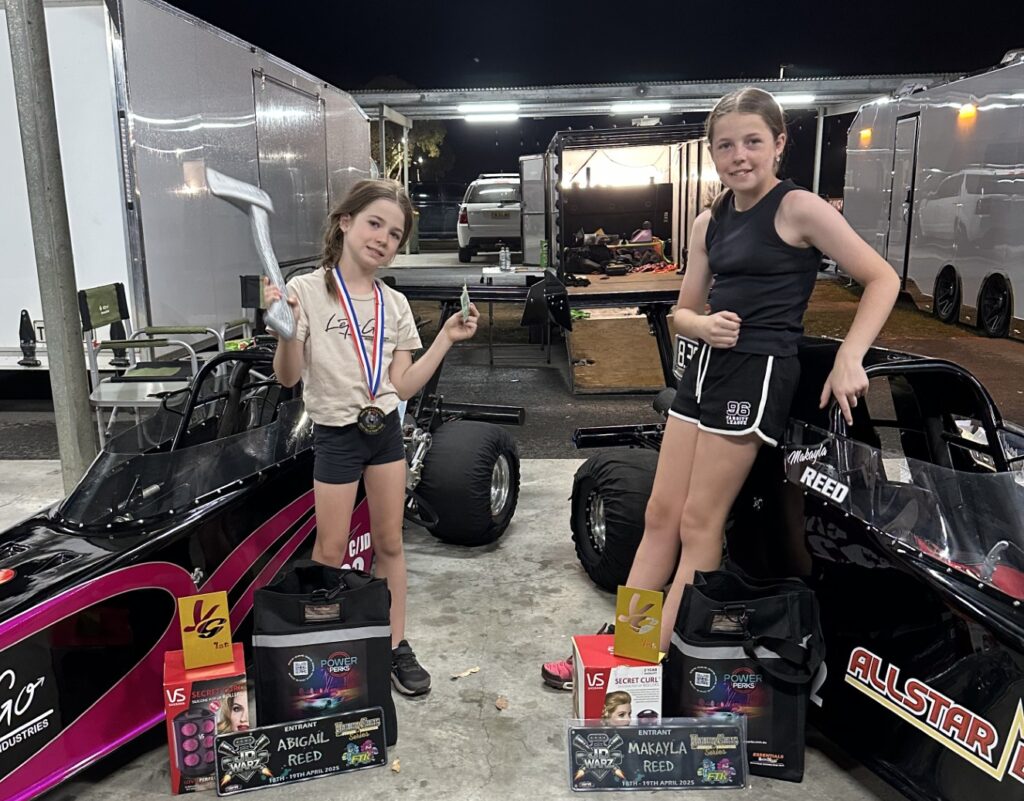
For Makayla and Abigail Reed, it feels like home.
“I’m happy to be here,” Makayla says.
“Exciting,” Abigail adds.
Drag racing has always been the foundation of the Reed family, but junior dragsters have changed the shape of it. What was once observation has become participation. What was once waiting has become preparation.
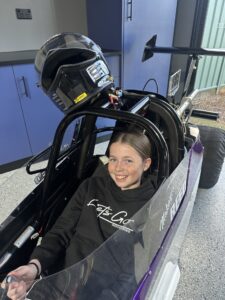
Makayla loves the driving.
Abigail loves the competition — “duh!”
Between rounds, time stretches. This is the part most people don’t see. Race vehicles cycle through in their brackets. Golf buggies move purposefully through the pits. Between qualifying runs, there is time to wait, to talk, to think. For the girls, there’s no frantic movement, no rush to change tyres or chase adjustments, and that often means a chance to kick a ball on the grass while they casually monitor the rounds on track.
Makayla knows exactly where she belongs in that space.
“The pit,” she says. “Because I can do whatever I want to.”
Abigail prefers the trailers — the familiar quiet between runs, the place where everything resets.
The competitiveness is always there. Asked what she admires about her sister’s racing, Makayla grins. “Nothing — I’m better.”
Abigail doesn’t argue. “She goes faster than me.”
When it’s time, they move with purpose. No wasted steps. No theatrics. Makayla takes deep breaths before staging, calm and methodical. Abigail doesn’t talk about nerves at all.
“I don’t get nervous,” she says. “Mum believes in me.”
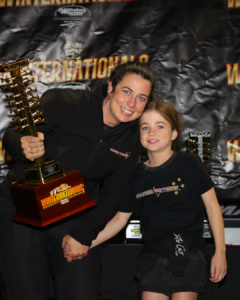
Waiting gives way to eliminations, and the atmosphere shifts. Finals don’t announce themselves loudly — they compress. Fewer cars. Shorter pauses. More weight in every run. The pressure isn’t chaotic; it’s absolute. You either advance, or you don’t.
Makayla felt that weight at the Junior Nationals in Mildura in 2024 — experience she brings back into every round at Portland. She arrived quietly, worked through round after round, and found herself staging for the final against Australian Champion Zayne Condello. By then, the start line had filled with kids cheering her name — friends made trackside, the same ones she talks to during the week, counting down to the next time they’ll race each other.
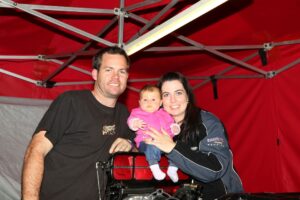
“I don’t think any of us will forget that moment,” her mum Fiona says.
Abigail’s milestones came with the same quiet certainty. At Heathcote, her reactions earned her a reputation — chopping the tree so cleanly that her opponents were left chasing her down the strip. At nine, smaller than many she lines up against, she already understands how races can be won before they unfold.

She reads the time card with a small grin when she knows she’s done her job — and is quietly tough on herself when it isn’t quite right. Encouraged by the older racers, she’s learning what good sportsmanship looks like, not because it’s taught formally, but because it’s modelled constantly.
Growing up at regional tracks like Portland has given both girls an understanding of racing that goes beyond trophies. They’ve seen what happens when things go wrong. Fires. Impacts. The sudden stillness that follows. Those moments don’t frighten them — but they do ground them.
In Sydney, both girls were on the tow car when Gary Phillips’ Funny Car caught fire — watching as their dad, still in his fire suit, ran toward the car before the driver appeared.
Makayla remembers towing back at Tailem Bend, passing Russell Mills’ accident — a moment etched into recent drag racing history, witnessed not from the stands, but from the return road beside it.
Safety isn’t theoretical here. It’s habitual. Non-negotiable.
There are softer rituals too. In the staging lanes, Fiona sings Golden to Abigail to make her smile before a run. Under the trees, waiting their turn, the girls kick a ball, talk about school, argue about who has to sit where in the tow car on the way back.
Being fourth-generation racers doesn’t feel heavy — not yet.
“Once the helmet is on, we are all the same.”
“It’s pretty normal,” Makayla shrugs. “Everyone else’s families race.”
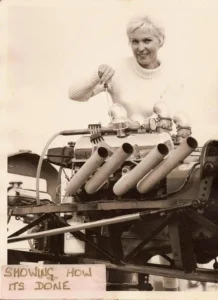
For Abigail, the history lives in quieter corners — the trophies at Nanni and G-Pa’s workshop, and the stories of her great-grandmother Nelma, the first woman to drag race in Australia.
Jimmy and Nelma’s names carry weight far beyond the family — Jimmy as a quiet pioneer whose craftsmanship, sportsmanship and generosity helped shape Australian drag racing, and Nelma as a woman who took her place on the track when few others did, proving that confidence and capability mattered more than convention.
But for the girls, they live most vividly in small things: ice creams in the freezer, time spent together away from the track, and the constant reminder to be kind, to listen, and to carry themselves with dignity.
“She was really brave,” Abigail says.
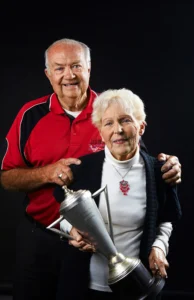
Pioneers of Australian drag racing, and quiet architects of a legacy built on respect, friendship and family.
Small pieces of jewellery containing the ashes of Jimmy and Nelma travel with the girls to the track. Not as a reminder of pressure — but of why kindness and respect matter as much as winning.
Away from racing, life continues. School. Training. Team sports. Makayla even missed the Winter Nationals this year to play representative sport for her hometown, before returning to her local team, where she was awarded Player’s Player and finished the season as leading goal kicker.
Makayla talks about the future with patience as much as ambition — about fundamentals, preparation, and earning each step before chasing anything bigger.
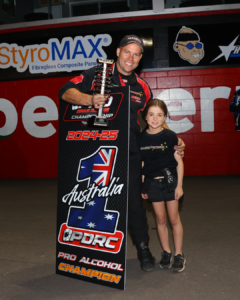
Makayla talks about the future with patience as much as ambition — about fundamentals, preparation, and earning each step before chasing anything bigger.
Her influence is Britney Olive — currently the only woman competing in Pro Alcohol in Australia — not just for what she’s achieved on track, but for the way she shows up off it.
“She always sends me inspirational messages,” Makayla says.
“I want to be the first female to win a Pro Alcohol Championship.”
Abigail’s vision is just as settled. “I want to drive a modified car and win.”
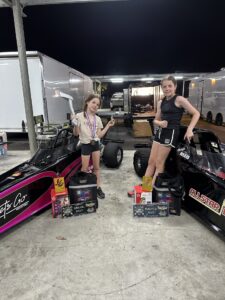
Racing, travelling, laughing — and building family along the way.
For now, success looks simple: show up, wait your turn, do the work, and leave knowing you gave it everything.
As Fiona puts it, whether they’re at a race track or a soccer pitch, the sign is the same — that small grin when they know they’ve done their best.
When asked what matters most for anyone wanting to race, Makayla doesn’t overcomplicate it.
“Start off slow.”
Abigail nods. “Be kind, listen, and work on your car.”


What’s your why? Whether you’re a racer, behind the camera, on the tools, or the loudest cheerleader, we want to hear your story! Share with us your passion and motivation to inspire others. Submit your story: https://bit.ly/4aYoxO4