

What Tyre Wear Can Tell Us About How a Vehicle Really Behaves
Most people look at a worn tyre and see a problem.
A mechanic sees an alignment.
A roadworthy inspector sees a defect.
A vehicle owner sees an expense.
Chris Preen sees evidence.
The distinction sounds subtle, but it fundamentally changes the way tyre wear is interpreted. During a discussion about alignment, suspension geometry and vehicle setup, I found myself returning to the same observation repeatedly: tyres are among the few components on a vehicle that provide a continuous physical record of what has happened to them. Every corner, every braking event, every load transfer, every compromise in suspension geometry eventually leaves a mark somewhere on the tread.
The challenge is deciding what that mark actually means.
Tyre wear has a habit of encouraging certainty. A vehicle arrives with worn inner edges and somebody declares the alignment incorrect. Outer-edge wear suggests something else. Feathering points to another diagnosis. Yet Preen’s first instinct is not to search for an answer. It is to study the pattern.
Context comes first.
 A tyre showing significant inner-edge wear may indicate a problem. Equally, it may indicate a suspension geometry operating exactly as intended. A vehicle running substantial negative camber already biases the contact patch toward the inside of the tread. Some degree of inner-edge loading is therefore expected. The same wear pattern observed on a vehicle with very little camber tells a different story.
Now toe enters the conversation.
In fact, toe appears repeatedly throughout discussions of tyre wear because even relatively small errors can create constant slip angles during straight-line driving. The tyre is no longer rolling cleanly along the road. It is being asked to travel slightly sideways at the same time, continuously scrubbing material from the tread. Camber receives considerable attention because it is visually obvious, but Preen notes that toe is often one of the first things worth checking when wear patterns begin to look unusual.
Even then, the tyre rarely provides a complete answer on its own.
Comparison becomes important.
If both front tyres exhibit similar inner-edge wear, toe-out becomes increasingly plausible. If both show outer-edge wear, toe-in deserves consideration. If the shoulders wear more heavily than the centre, tyre pressure becomes relevant. If the centre wears faster than the shoulders, the discussion shifts again.
The tyre is not supplying conclusions.
It is supplying clues.
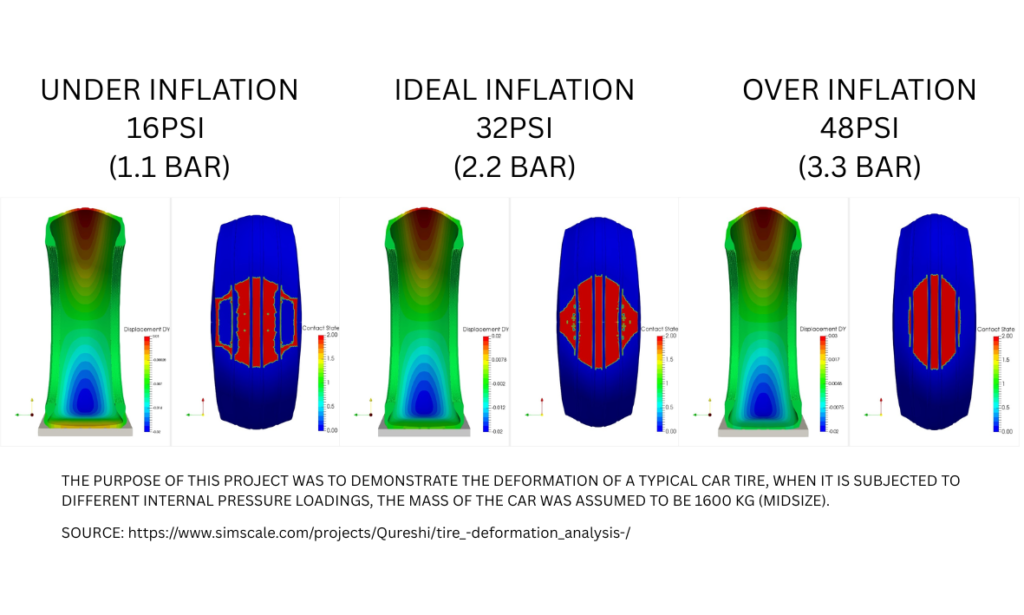
One of Preen’s more useful analogies is that a tyre behaves much like a reinforced balloon. Reduce the inflation pressure and the structure deforms, allowing the shoulders to carry a greater proportion of the load. Increase the pressure and the centre bulges outward, concentrating load there instead. The tyre itself has not changed. The way it carries force has.
That idea extends well beyond inflation pressure.
Road conditions leave evidence. So do driving habits. A vehicle that spends its life negotiating roundabouts and suburban intersections may exhibit wear patterns that differ substantially from one used primarily on highways. Road crown can influence loading. Consistently driving on the same side of the road can influence loading. Repeatedly asking a tyre to perform the same task eventually leaves a signature.
Even the texture of the tread can become informative.
A smooth, polished surface often suggests gradual mechanical scrubbing. Feathered edges, graining or torn tread blocks point toward heat, slip and higher energy inputs. The tyre is recording not only what the vehicle is, but what the vehicle does.
The conversation becomes more interesting when modifications enter the picture.
Consider the common example of adding a bullbar, winch or other front-end accessories. The obvious consequence is additional mass. The visible consequence is reduced ride height. The less obvious consequence is that the suspension may now be operating in a different part of its travel range.
Preen argues that the significance depends heavily on the original geometry.
A modest change may require little more than an alignment. A larger change can alter the relationships between suspension components themselves. Control arms move through different arcs. Tie rods move through different arcs. Steering arm angles change. At some point, the discussion stops being about alignment values and starts becoming a discussion about geometry.
This is where concepts such as bump steer become important.
Bump steer describes a change in toe as the suspension moves through its travel. In an ideal world, the wheel would maintain the intended steering relationship throughout that movement. In reality, geometry introduces compromises. As ride height changes and components move through different positions, the wheel can begin steering itself slightly as the suspension compresses and rebounds.
A wheel alignment may reveal the symptom.
It may not reveal the cause.
The same principle appears when discussing camber, caster and toe.
Alignment sheets encourage the idea that these are separate adjustments. Camber occupies one box. Caster occupies another. Toe occupies another again.
The tyre experiences none of them individually.
It experiences the combined result.
Preen uses the example of a MacPherson strut suspension. Increase caster and the wheel can generate additional negative camber as steering angle increases. Introduce king pin inclination (KPI)* and the relationship changes again. KPI—the angle of the steering axis relative to vertical—helps determine how the wheel tips as it turns, influencing how camber behaves dynamically. Manufacturers typically fix KPI as part of a broader design compromise, but its influence remains present every time the steering wheel is turned.
The alignment printout may show separate values.
The tyre sees a single reality.
This distinction becomes even more important in motorsport.
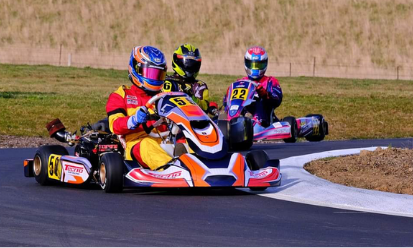 On a race car, alignment settings are rarely judged by whether they minimise wear in isolation. More negative camber may increase wear in one area while protecting another. A setup that improves tyre life may compromise grip. A setup that generates maximum grip may reduce tyre life. Driver confidence enters the equation. Vehicle balance enters the equation. Lap time enters the equation.
The discussion shifts from correctness to compromise.
There is always an optimal setting in theory.
There is rarely one that is optimal everywhere.
Perhaps the most revealing observation from our conversation concerns the difference between static measurements and dynamic behaviour. Alignment values are measured with the vehicle stationary, sitting on an alignment rack. The tyre never experiences those conditions on the road.
The tyre experiences braking.
Acceleration.
Cornering.
Compliance.
Load transfer.
Deflection.
 Without sophisticated kinematic and compliance testing, engineers often rely on the tyre itself to understand what is happening dynamically. Temperatures. Pressures. Wear patterns. Surface condition. Driver feedback. Together they provide a picture of how the vehicle behaves once forces begin acting on it.
Compliance plays a particularly important role here.
Bushes flex. Chassis structures flex. Components deflect. In a perfect world, every part of a suspension system would remain exactly where the designer intended. In the real world, every component moves to some degree under load. If that movement is predictable, engineers can account for it. Static toe-out, for example, may be introduced so that the wheel reaches the desired position once compliance and loading effects occur during operation.
Unexpected behaviour often reveals itself through the tyre first.
A vehicle exhibiting rear toe-out under acceleration may be experiencing bush compliance. It may be responding to spring rates. It may be responding to damper settings, anti-squat geometry or bump steer characteristics. The visible symptom appears at the tread surface, but the explanation may lie elsewhere in the vehicle entirely.
This is one reason Preen is cautious about using alignment as a universal solution, particularly when discussing heavier or higher-torque vehicles.
As vehicle mass and torque increase, particularly in modern EV platforms, it can be tempting to compensate for unwanted behaviour through alignment changes alone. Preen’s view is more conservative. In a well-engineered vehicle, the suspension and steering systems should be sufficiently stiff to maintain their intended geometry under load. Alignment can be used to fine-tune behaviour, but it should not become a substitute for structural integrity. If components are deflecting beyond their intended range, the more fundamental solution may be to address the stiffness of the system itself rather than introducing further alignment compromises.
That idea feels representative of the broader discussion.
Throughout our conversation, Preen consistently returned to the difference between static measurements and dynamic behaviour. Alignment values are useful, but the tyre never experiences those values in isolation. It experiences the combined result of geometry, pressure, compliance, load transfer, road conditions, driver inputs and the countless compromises built into the vehicle itself.
A wheel alignment report may display camber, caster and toe as separate numbers. The tyre sees only the outcome.
Perhaps that is why tyre wear can be so difficult to interpret. A worn shoulder, a feathered tread block or a polished surface rarely points neatly to a single cause. More often, it reflects the interaction of multiple systems operating simultaneously. The visible wear pattern is not necessarily the source of the problem, nor is it always evidence of a fault. Sometimes it is simply the consequence of the compromises required to make the vehicle perform the way it does.
There is always an optimal setting in theory, but rarely one that is optimal everywhere. Every adjustment solves one problem while introducing another. More camber may improve cornering performance while increasing wear elsewhere. Additional stiffness may improve consistency while reducing compliance. A setting that feels excellent in one condition may prove less effective in another.
 The engineer’s task is not to chase a perfect number. It is to understand how the vehicle behaves as a system and to keep the tyre operating within the most useful part of its range.
In that sense, the tyre is less a component than a record. Every kilometre, every corner, every load change and every setup decision eventually leaves its mark somewhere on the tread. The challenge is learning to distinguish between the mark itself and the story that produced it.
* Also called Steering Axis Inclination (SAI)


Blossom Fernandez is an automotive engineer specialising in electric vehicle systems and standards. She contributes to EV standards committees and supports emerging engineers through mentoring and STEM engagement. Blossom is a relentless learner committed to growth, challenge, and constant evolution.