

Designing a Digital Identity On and Off the Track
At a certain point in a motorsport career, progress stops being about talent alone.

Not because the driver has stalled, but because the environment has changed. The scrutiny is higher. The stakes are broader. Decisions made off-track begin to echo just as loudly as those made on it.
This is where many capable women feel an invisible friction. They are doing the work. They are showing up. Yet opportunity feels inconsistent, fragile, or strangely conditional.
Increasingly, the difference is not performance.
It is how legible their professionalism is online.
In modern motorsport, digital presence has quietly become part of the program.
From visibility to legibility
The assumption that success requires constant posting is one of the most persistent myths in the sport.
What teams, sponsors, and media actually respond to is not volume, but signal clarity.
Scroll through the online presence of women who convert momentum into longevity and a pattern emerges. Their profiles are consistent. Their bios are restrained. Their content explains process rather than emotion. Losses are acknowledged without being litigated. Wins are contextualised rather than inflated.
Nothing feels accidental.
This is not influencer culture. It is reputation management under load.
In motorsport, legibility matters because it reduces perceived risk. When a name is predictable, it becomes attachable — to a logo, a contract, a media brief, or a sponsorship deck. Popularity may spike attention, but legibility compounds trust.
 Treating digital presence as infrastructure
Professionals do not treat their online presence as an outlet. They treat it as infrastructure.
Race updates are brief and factual. Debriefs focus on learning rather than blame. Behind-the-scenes content shows preparation: engineering choices, fitness routines, logistics, travel, community engagement. Sponsors are integrated through use and explanation, not logo saturation.
The tone signals seriousness without stiffness.
Consistency matters more than frequency. Two or three quality posts a week, sustained over time, communicates far more stability than sporadic bursts of intensity. Even a simple media kit — a single page outlining results, audience reach, and sponsor outcomes — reframes an athlete or professional as a safe commercial decision.
What this communicates, quietly but clearly, is intent.
The cost of oversharing
Oversharing rarely feels reckless in the moment. It feels human.
The problem is permanence.
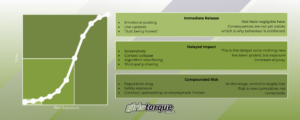
Screenshots flatten context. Algorithms reward escalation. Posts written in emotion are rarely read with generosity once detached from their original moment.
For motorsport professionals, this creates three forms of risk: physical safety, identity security, and reputational drag.
Experienced operators develop unspoken rules. Homes are not shown. Travel is posted after the fact. Passes, documents, barcodes, and licence plates remain off-camera. Emotional responses are drafted privately, then either refined into something constructive or deleted entirely.
This is not silence. It is control.
In a sport where judgement at speed is celebrated, emotional restraint online is read as the same thing: decision-making under pressure.
 Digital footprints and professional memory
Motorsport has a long memory, and so does the internet.
Teams, sponsors, and employers routinely review not just what someone posts, but how they engage. Comments. Likes. Tagged photos. Old jokes that aged badly. Arguments that never truly disappeared.
The women who endure treat their public accounts as if they will one day be printed and attached to a contract file — because often, they are.
This does not mean erasing personality. It means separating channels. Public motorsport accounts remain professional and forward-facing. Private accounts are locked down and genuinely private. The boundary is clear, and therefore defensible.
When something does surface — as it occasionally will — prepared professionals respond quickly, specifically, and without drama. They own what needs owning, demonstrate change, and move forward. What matters is not flawlessness, but coherence over time.
Motorsport culture rewards craft
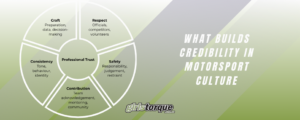
Despite the glamour often associated with the sport, credibility in the paddock is still earned the old-fashioned way: through understanding.
Drivers who speak about decision-making, preparation, data interpretation, recovery, and teamwork build respect across disciplines. Engineers recognise them. Media trusts them. Sponsors understand how to frame them.
Those who default to spectacle eventually discover the ceiling it creates.
Motorsport culture values resilience, respect for safety, and technical literacy. Strong opinions are acceptable; public disrespect is not. Humour is welcomed; recklessness is not. The paddock notices who thanks their crew, acknowledges officials, and elevates volunteers and juniors.
Behaviour compounds.
 Living at the crossroads
Very few modern women in motorsport occupy a single role.
They are engineers on weekdays and competitors on weekends. Media professionals, mentors, mechanics, managers, and advocates — often simultaneously. The challenge is not choosing one identity, but sequencing them without conflict.
The most effective professionals define a clear public character — a small set of traits they are consistently known for — and let those traits guide every interaction. Platform roles are intentional. LinkedIn and websites document outcomes and partnerships. Instagram and video platforms centre motorsport, with controlled personal context. Private spaces remain private.
Red-line topics are decided early and defended consistently. Emotional posts are delayed, rewritten, or discarded. Off-track careers are integrated thoughtfully, increasing employability and relevance beyond results alone.
The result is not fragmentation, but coherence.
The advantage of intention
The women who do this well rarely describe it as branding.
They describe it as making their life easier.
Fewer misunderstandings. Fewer explanations. Fewer doors quietly closing without warning. Opportunities arrive with less friction because trust has already been established.
In a sport built on marginal gains, digital intention becomes one of the quietest — and most powerful — advantages available.
Modern motorsport professionals are not louder than their predecessors. They are clearer. Not more visible, but more deliberate.
And increasingly, that clarity is what keeps them in the room.

Bridget Bell is a seasoned motorsport media professional and a skilled mechanic, with over a decade of experience in On-Air Hosting, Event Hosting, Television Presenting and Commentating. Passionate about supporting women in both the industry and motorsport, Bridget volunteers as a mentor and actively champions female representation.
Disclaimer: While due research has been conducted, the views expressed in our articles are those of the author and may not necessarily reflect everyone’s views. If you notice an error, please email quoting the blog article title and an explanation of the error.