

Building an Accessible Future for Australian Motorsport
An AWMN × Accessible Racing Life Special Sector Report for International Day of People with Disability (IDPwD) 2025
Under the soft hum of an early morning television, a young girl sat awake while the rest of the world slept. Chronic pain had become a constant companion, but so too had the rhythm of Formula 1—the only other thing awake at that hour. “It was either infomercials or F1,” Rachel recalls now, remembering the nights that sparked her lifelong connection with motorsport.
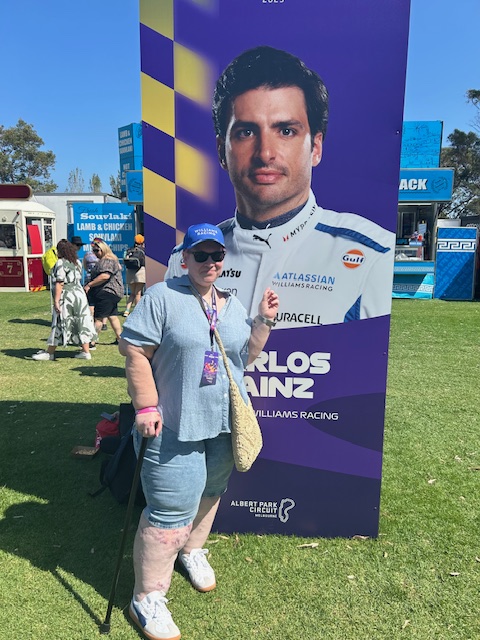
Years later, that same woman leads Accessible Racing Life, using her lived experience to illuminate the challenges and opportunities that define accessibility in Australian motorsport. Her story reminds us that inclusion is a matter of practical design, education, and the courage to listen.
Motorsport celebrates difference in almost every form—engineering precision, driving styles, team strategy—yet the diversity that powers its machinery hasn’t always extended to its people. As Rachel puts it, “Disability often remains underrepresented and, at times, completely overlooked.”
While inclusion efforts have accelerated for gender and culture, disability remains a quiet corner in the conversation. It is a dichotomy worth examining: an industry built on innovation, still realising how to innovate socially.
Legislation and the Realities of Access
Australia’s Disability Discrimination Act (1992) and the Disability Access to Premises Standards (2010) are clear—access is not optional. Policies across Australian governing bodies map out these principles (including Motorsport Australia’s DEI Policy), as do the FIA’s global frameworks for adaptive participation.
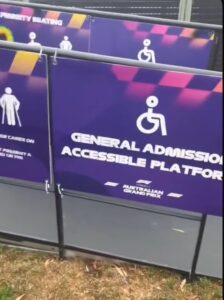 In practice, Rachel notes, that pathway often feels steep. “It should not be about their preferences,” she says of event organisers, “it’s about what we as fans need.” F1’s Australian Grand Prix Corporation has begun seeking consultation from fans with disability, but Rachel’s experience suggests the process can still be paternalistic—focused on being seen to listen, rather than listening to understand.
Grassroots motorsport, she observes, is showing quieter but steadier progress: “Coaches are really embracing the diverse needs of their mentees right from the beginning.”
Education, Rachel insists, is the most cost-effective adjustment any organisation can make. “Inclusion isn’t another cut-and-paste course from the archives—it’s a real-world learning experience.”
But training alone isn’t enough. “There’s a lot of unchecked bias,” she adds. “Will this person be too slow? Will they be able to do the job? Are they going to get overwhelmed?” These are the quiet assumptions that education must challenge—not through reprimand, but through exposure, curiosity, and conversation.
This kind of manuductive learning—guided by the hands and experiences of those who live the realities of disability—transforms theory into empathy. True accessibility training doesn’t start with policy manuals; it starts with conversation.
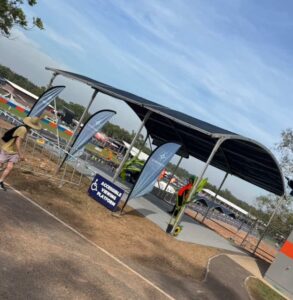 As Bridget Bell from the Australian Women’s Motoring Network observes, “There’s a social responsibility to engage stakeholders with lived experience. Pick up the phone. Ask from a place of curiosity, not fear of cost. Work out what capital expenditure actually looks like, and what you can do now with the resources you already have.”
When Policy and Reality Collide
Motorsport Australia’s medical standards allow competitors with impairments to race if they can demonstrate safe control and extraction from a vehicle within ten seconds. It’s a sound policy—but, Rachel says, the burden often rests entirely on the individual. “There’s still this underlying bias of ‘can the person really do this?’”
The licensing pathways exists, but without disability-specific guidance, lived experience remains sidelined. “I have tried to reach out to multiple people at Motorsport Australia to try and collaborate on making this part of the structure, but have had no reply thus far.”
Innovation as Inclusion
For Rachel, technology isn’t a luxury—it’s liberation. Adaptive innovation has the power to turn exclusion into opportunity when guided by empathy and evidence.
In Australia, disability controls for vehicles are already part of a mature and carefully regulated field. Under AS 3954:2019, adaptive driver systems must meet performance-based standards that ensure both safety and flexibility, supported by state-level certification schemes like NSW’s Vehicle Safety Compliance Certification Scheme (VSCCS).
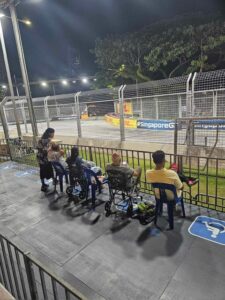 Adaptive simulators could become the bridge between these established standards and motorsport’s competitive environment. As Rachel notes, simulators offer a low-risk, data-driven environment to test adaptive controls and gather measurable proof of driver proficiency—mirroring systems already validated by industries like mining and aviation.
Building on the concept proposed by Rachel Durrington, a plug-and-play philosophy could offer a modular approach to adaptive control design—supporting flexible, transferable use across vehicles. It’s a concept that could be further explored through collaborative research between university engineering teams, allied-health specialists (e.g., occupational therapists), and motorsport innovators, where accessibility and performance meet in design.
Meanwhile, inclusive performance analytics—the next evolution of telemetry-based coaching—can help reshape how data informs learning. The technology itself isn’t new, but the interpretation could be adapted. Instead of comparing drivers with disabilities against able-bodied benchmarks, adaptive analytics would calibrate training to each individual’s physical capacity, fatigue threshold, and control-input style to reframe performance data through an empathetic lens.
Looking forward, AWMN has identified an opportunity for the sport’s coaching community to join this conversation. Driver coaches with experience training people with disabilities could share practical insight alongside lived-experience advocates and engineering experts. With support across motorsport’s governing bodies, this collaboration could ultimately produce an inclusive coaching framework—one grounded in safety, empathy, and measurable outcomes—helping to shape motorsport’s next generation of accessible competition.
Progress in motorsport has always come from reengineering what has been superseded. When hybrid technology changed the availability of the crank to generate power, engineers reimagined how auxiliary systems could function. Inclusion demands a similar shift in thinking: rather than relying on what has always been done, we can design new pathways that draw power from innovation itself.As Rachel puts it, “Manufacturers improving their designs for us can become blueprints for everyone.”
The Human Cost of Exclusion
At this year’s Australian Grand Prix, Rachel and her son waited for an accessible shuttle that never came. The missed paddock tour wasn’t just a lost experience—it was a reminder of the fragility of belonging. “It broke my heart,” she shares. “The chance of a lifetime just slipped away from me because my body has all of these inconsistencies that make an act as simple as walking difficult.”
Months later, she found herself at Queensland Raceway, welcomed by racer Ben Taylor and his family. “They were so warm, so encouraging. I just felt like, hey, I can do this.” The same sport, two entirely different experiences: one exclusionary, one empowering.
Representation and the Power of Visibility
Representation, Rachel says, “challenges the narrative of what is ‘normal’ in motorsport.” At present, visibility tends to be reserved for famous figures; few everyday fans, officials, or journalists with disabilities are seen.
“People with disabilities and diverse needs are inspirational, they’re just regular people trying to break down barriers so that they can be accepted as normal” she explains. “There is no tragedy in having a disability.”
Visibility creates culture. It tells future fans that there’s space for them in the paddock. It helps clubs and governing bodies see not problems to be solved, but perspectives to be included.
The future of accessibility in Australian motorsport, Rachel believes, will depend on the sport’s willingness to remain opsimathic—to keep learning, even late in its evolution.
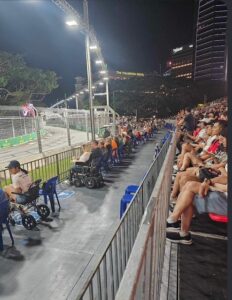 That means embedding education at grassroots competition, improving signage and infrastructure, providing quiet zones for sensory regulation, and creating pathways and grants that help disabled competitors move from karts to cars. It means representation that celebrates all disabilities, not just the visible ones.
Her message to organisers and sponsors is simple: “Please don’t be afraid to utilise advocates such as myself, with knowledge, education, skills and lived experience, to make motorsport more accessible for everyone. Inclusion is not a trend—it’s a culture we need to embed in every single person who is involved in the motorsport community.”
Through the paddock gate lies not just the track, but the possibility of transformation. Accessibility, when approached with curiosity and courage, is not a compliance exercise—it’s the next frontier of innovation and humanity in the sports we love.
Legislation and Regulatory Framework
-
Disability Discrimination Act 1992 (Cth) – Australian Government, Federal Register of Legislation.
https://www.legislation.gov.au/Details/C2018C00125 -
Disability (Access to Premises – Buildings) Standards 2010 – Australian Government, Attorney-General’s Department.
https://sport.vic.gov.au/resources/disability-access-to-premises-buildings-standards-2010 -
Australian Human Rights Commission – Disability Rights: Access to premises FAQs and legal guidance.
https://humanrights.gov.au/our-work/disability-rights/frequently-asked-questions-access-premises -
AS 3954:2019 – Motor Vehicle Driver Controls – Adaptive Systems for People with Disabilities – Standards Australia.
https://www.standards.org.au/news/motor-vehicle-controls-standard-is-revised-to-help-increase-driver-safety -
Vehicle Safety Compliance Certification Scheme (VSCCS) – Transport for NSW, Vehicle Standards Information No. 21.
https://www.nsw.gov.au/sites/default/files/2021-03/vsi-21-guidelines-for-modifying-vehicles-for-people-with-disability.pdf
Motorsport Regulation and Policy
-
Motorsport Australia – Diversity, Equity & Inclusion Policy
https://motorsport.org.au/clubs/resources/diversity-inclusion/ -
Motorsport Australia – Medical Standards & Self-Extraction Requirements
https://motorsport.org.au/wpblob0fe832abcb/wp-content/uploads/docs/default-source/medical/medical-standards.pdf
https://motorsport.org.au/regulations/safety-integrity/self-extraction-requirements/ -
FIA Disability and Accessibility Commission (DAA) – Fédération Internationale de l’Automobile.
https://www.fia.com/disability-accessibility-commission
Accessibility in Sport & Infrastructure
-
Sport Victoria – Design for Everyone: A Guide to Sport and Recreation Settings
https://sport.vic.gov.au/__data/assets/pdf_file/0005/2268761/Design-for-Everyone-Guide-A-Guide-to-Sport-and-Recreation-Settings.pdf -
Tennis Australia SA – Wheelchair Venue Accessibility Guide
https://www.tennis.com.au/sa/files/2023/07/Wheelchair-Venue-Accessibility-Guide.pdf -
Australian Racing Drivers’ Club (ARDC) & Racing with Autism Australia Collaboration
https://www.ardc.com.au/racing-with-autism-australia-and-ardc-collaborate-to-make-motorsport-more-accessible/ -
Motorcycling Victoria – Catalyst Motor Sport Program
https://www.motorcyclingvic.com.au/catalyst-motor-sport-helping-people-with-disabilities-watch-motorsport-trackside/
Adaptive Driving Industry and Service Providers
-
Mobility Engineering – Introduction to Hand Controls for Disabled Drivers
https://www.mobilityengineering.com.au/introduction-to-hand-controls-for-disabled-drivers/ -
Driving Mobility – Understanding Manual Hand Controls
https://drivingmobility.com.au/understanding-manual-hand-controls/ -
TADWA – Recreation and Mobility Services / Vehicle Mobility
https://tadwa.org.au/our-services/recreation-and-mobility-services/vehicle-mobility/ -
Blue Badge Insurance – A–Z Guide for Disabled Drivers
https://www.bluebadgeinsurance.com.au/wp-content/uploads/2021/08/BBI_A-Z-Guide_Updated_2019.pdf -
Norden Group – Vehicle adaptation and accessibility systems.
https://www.norden.com.au -
Mobility Plus – Hand Controls and Vehicle Modification Services.
https://www.mobilityplus.com.au/hand-controls -
Total Ability – A History of Driving Controls for People with Disability
https://totalability.com.au/a-history-of-driving-controls-for-people-with-disability/
Broader Disability and Inclusion Resources
-
People with Disability Australia (PWDA) – Key Disability Legislation
https://pwd.org.au/about-us/about-disability/key-disability-legislation/ -
National Disability Insurance Scheme (NDIS) – Vehicle modification funding guidelines.
https://www.ndis.gov.au/ -
Sport Inclusion Australia – Inclusive Organisations and Programs
https://sportinclusionaustralia.org.au/inclusion-organisations/
Community and Campaign Materials
-
International Day of People with Disability (IDPwD) – Official Website and Community Information Kit (2025)
https://www.idpwd.com.au/ -
Australian Bureau of Statistics – Disability, Ageing and Carers: Summary of Findings (latest release)
https://www.abs.gov.au/statistics/health/disability/disability-ageing-and-carers-summary-findings/latest-release
Primary Contributor
- Rachel Durrington – Accessible Racing Life, 2025 FIA – Fédération Internationale de l’Automobile -Empowering Disabled Motorsport Award Nominee.
Original commentary, lived experience insights, photographs and direct quotes contributed for this report.

Bridget Bell is a seasoned motorsport media professional and a skilled mechanic, with over a decade of experience in On-Air Hosting, Event Hosting, Television Presenting and Commentating. Passionate about supporting women in both the industry and motorsport, Bridget volunteers as a mentor and actively champions female representation.
Disclaimer: While due research has been conducted, the views expressed in our articles are those of the author and may not necessarily reflect everyone’s views. If you notice an error, please email quoting the blog article title and an explanation of the error.