

When a Car Can’t Crash the Way It Was Designed To
Most people look at crash photos and instinctively ask the same question:
How fast were they going?
It’s a reasonable assumption. We tend to associate severe damage with severe speed. The more twisted the metal, the faster the vehicle must have been travelling.
As an engineer, I often find myself asking a different question.
Where did the force go?
That’s because the severity of a crash isn’t determined solely by speed. Just as important is where the impact force enters the vehicle and how that force travels through the structure.
Looking at these images, the first thing that stands out to me isn’t the damaged front end.
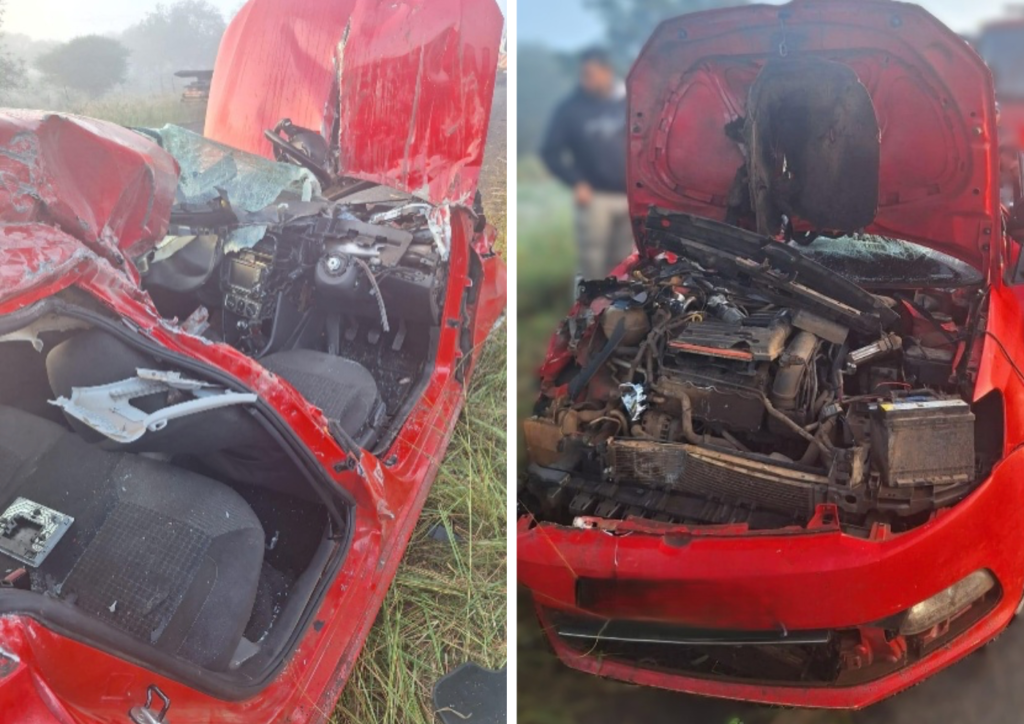 It’s how high the damage reaches.
The bonnet has folded upward into the windscreen area. The A-pillar—the structural post beside the windscreen—has suffered significant deformation. The roof structure shows evidence of collapse. Meanwhile, portions of the lower front structure remain recognisable despite the severity of the overall damage.
That combination tells an interesting story.
Modern passenger vehicles are designed to crash in a very specific way.
Every crumple zone, reinforcement beam and structural member forms part of what engineers call a load path. A load path is simply the route a force is intended to travel through a structure.
In a typical frontal collision, the front of the vehicle sacrifices itself. The crash energy enters the bumper and crush structures, then progressively travels through components specifically designed to absorb energy before it reaches the passenger compartment.
When that process works as intended, the vehicle is effectively buying time and space for the occupants.
The challenge arises when the force enters somewhere it wasn’t expected.
In this case, the damage profile suggests a significant vertical mismatch between the two vehicles involved.
Vertical mismatch occurs when the major structural components of one vehicle sit substantially higher than those of the other. Instead of bumper meeting bumper or crash structure meeting crash structure, the taller vehicle can engage higher sections of the smaller vehicle.
Engineers sometimes refer to this as an override event.
Rather than engaging the sedan’s primary energy-absorbing structures, the impacting vehicle appears to have bypassed much of the designed crumple zone and transferred force into the upper engine bay and firewall area.
In simple terms, the crash may have entered the car above its strongest line of defence.
That changes everything.
Instead of allowing the lower crash members to progressively absorb energy, the impact appears to have forced the bonnet upward and directed load into the A-pillar and roof structure far earlier than the vehicle’s designers intended.
This is why understanding load paths matters.
The force isn’t disappearing. It’s simply taking a different route.
Once the intended load path is bypassed, the vehicle can lose much of its ability to manage crash energy in a controlled way. The result is often more rapid intrusion into the occupant compartment and damage patterns that appear disproportionate when compared with the visible front-end deformation.
Another detail worth noting is the asymmetry of the damage.
The vehicle does not appear to have absorbed the impact evenly across its front structure. One side seems to have engaged before the other.
This introduces something engineers call rotational loading.
Most people understand compression. If you squeeze an empty aluminium can between your hands, that’s compression.
Rotational loading is different. Imagine squeezing the can while simultaneously twisting it.
The structure now has to deal with multiple forces at the same time.
Engineers refer to this twisting action as torsion.
When compression, bending and torsional loads occur together, structural members can exceed their design limits far more quickly than they would under a straight, symmetrical impact.
Looking at these images, the uneven collapse of the A-pillar and roof suggests the vehicle may have experienced exactly this combination of loading.
The structure wasn’t simply being pushed backward.
It was being pushed, bent and twisted simultaneously.
That significantly accelerates deformation.
The final piece of the puzzle may be visibility.
The conditions appear misty, which introduces additional uncertainty into both human and automated decision-making.
Reduced visibility shortens the time available to identify a hazard and react appropriately. Even a small reduction in reaction time can have a significant effect on residual impact speed because less braking occurs before contact.
Many readers may wonder whether modern driver assistance systems could have prevented the collision.
The answer is that it depends.
Systems such as Autonomous Emergency Braking, forward collision warning and radar-based detection technologies are incredibly effective when operating within the conditions they were designed to manage.
However, those systems are not magic.
Camera-based systems rely heavily on visibility and contrast. Radar can often detect objects through conditions that challenge cameras, but detection is only part of the process. The vehicle must still correctly classify the threat, predict its movement and determine whether intervention is appropriate.
Large vehicles, unusual impact angles, poor visibility and significant height differences can all introduce uncertainty.
In situations like this, the geometry of the crash can become just as important as the speed itself.
And that’s perhaps the most important lesson hidden within these images.
Crash damage is not simply a measure of how fast a vehicle was travelling.
It is a record of how forces moved through a structure.
Every collapsed pillar, folded panel and distorted seam tells part of that story.
The challenge—and the fascination—is learning how to read it.


Blossom Fernandez is an automotive engineer specialising in electric vehicle systems and standards. She contributes to EV standards committees and supports emerging engineers through mentoring and STEM engagement. Blossom is a relentless learner committed to growth, challenge, and constant evolution.