

Why some low-speed crashes cause surprisingly expensive damage
Most drivers have witnessed it at some point.
A crowded shopping centre carpark. A tight suburban intersection. A momentary lapse in concentration while manoeuvring. Two vehicles make contact at little more than walking pace and everyone involved breathes a sigh of relief. Nobody is hurt. There are no deployed airbags, no crumpled bonnets, and no dramatic scenes for the evening news.
Then the repair quote arrives.
Suddenly a collision that occurred at barely more than parking speed has produced thousands of dollars in damage. Panels have been torn away, doors no longer line up properly, and what initially looked like a minor scrape appears far more serious than anyone expected.
As an engineer, these are often the collisions I find most interesting.
High-speed crashes usually produce predictable outcomes. The forces involved are significant, the damage paths are relatively obvious, and the evidence is often easy to interpret. Low-speed incidents are different. They can create damage patterns that seem completely disproportionate to the speed involved, leaving drivers wondering how so much damage occurred from what felt like such a minor impact.
The answer lies in understanding that crash damage is not simply a measure of speed. It is a record of how forces travelled through a structure, where those forces were concentrated, and what failed first.
The first clue in this case lies in what didn’t break.
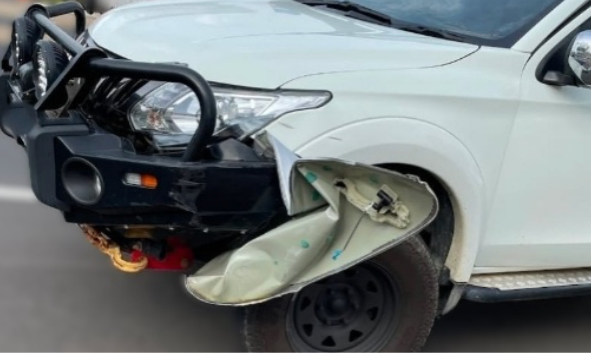
The ute’s bull bar remained largely intact while the bumper cover and guard had separated from the vehicle. At first glance, it would be easy to assume the plastic panels themselves failed under impact. In reality, the evidence suggests something quite different.
Engineers often look first at whether a component failed within the material itself or at the interface where it connects to something else. In this case, the damage appears to indicate failure at the mounting interfaces rather than within the bulk material. In simple terms, the plastic panels did not shatter or tear apart through their main structure. Instead, the clips, fasteners and mounting brackets that secured them to the vehicle failed first.
Those mounting points were likely subjected to a combination of bending and shear loads. Shear occurs when a force tries to slide one surface across another, while bending forces attempt to flex a component beyond its design limits. Imagine trying to pull a drawer sideways while simultaneously lifting it upward. It is not difficult to see how the runners would fail before the drawer itself.
This distinction matters because it tells us where the energy went.
Rather than the impact being absorbed through broad deformation of the panel, the load concentrated at specific attachment points. The panel survived. The connections did not.
The intact bull bar tells another part of the story.
Bull bars create a rigid load path through the vehicle. A load path is simply the route a force takes through a structure. Because the bull bar is significantly stiffer than the surrounding bodywork, it allows forces to travel through the vehicle differently than they would through a standard bumper assembly.
In practical terms, this means less deformation of the bull bar itself and greater force concentration into whatever the bull bar contacts.
The damage pattern on the hatchback reveals something even more interesting.
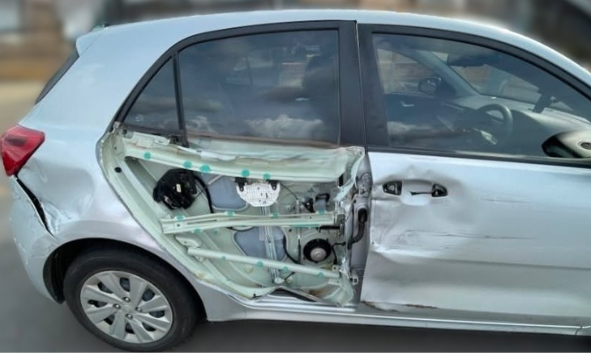 Many people would assume the torn door was the point of first contact. Looking at the evidence, I believe the collision actually began further rearward, near the transition between the rear bumper and rear quarter panel.
What makes this case particularly interesting is that the point of contact appears to have migrated as the collision progressed.
The initial load input appears to have occurred near the rear bumper corner. As the vehicles continued moving relative to one another, contact migrated forward into the rear door structure. This progression matters because the forces acting on the vehicles changed as the interaction evolved.
Initially, the collision was primarily compressive.
Compression is exactly what it sounds like: one object pushing directly into another. Most people instinctively picture vehicle collisions this way. Two surfaces meet and crush together.
However, once a protruding edge—possibly part of the bull bar or bumper assembly—engaged the trailing edge of the rear door skin, the nature of the collision changed entirely.
At that point, the force vector shifted.
Rather than simply pushing into the hatchback, the ute began dragging along its side. Engineers would describe this as a transition from compressive loading into a tangential drag force. In everyday language, the collision changed from a pushing action into a pulling action.
That distinction is critical because it changes the failure mode.
A failure mode is simply the manner in which something breaks.
Crushing and tearing are very different failure modes.
Crushing generally requires significant energy because material is being compacted and deformed across a broad area. Tearing and peeling can occur with comparatively modest forces once an edge or seam has been captured.
The easiest way to visualise this is to think about removing a sticker from a window. Pressing directly into the sticker does very little. Lift one corner, however, and the entire sticker can be peeled away with relatively little effort.
The same principle appears to have occurred here.
Once the rear door skin was effectively hooked, continued movement created a progressive peeling mechanism. Rather than crushing the panel, the interaction began pulling material away from the vehicle structure.
This helps explain why the damage appears so dramatic despite the relatively low speed involved.
The most dramatic damage is not always where the collision began.
The rear door experienced the primary failure event. The front door appears to have been affected later as the loads transferred forward through the remaining structure. This explains why the front door exhibits deformation but not the same degree of skin separation seen in the rear door.
For repairers, crash investigators and engineers, understanding this sequence is often more important than simply identifying where the biggest dent exists.
One of the more unusual observations involved the displaced door skin entering the ute’s wheel arch area. While this may sound alarming, the physics are surprisingly one-sided.
The tyre, wheel assembly and suspension components possess significantly greater stiffness and mass than a thin section of automotive sheet metal. Engineers sometimes refer to this as a stiffness mismatch.
In situations like this, the tyre generally wins.
The likely consequences are abrasion of the tyre surface, distortion of plastic wheel arch liners, damage to splash guards, or interference with nearby components such as wiring. The thin door skin continues to deform and fold while the tyre and wheel assembly remain largely unaffected.
Perhaps the most interesting lesson from this incident is what it reveals about modern vehicle safety systems.
Many drivers have become accustomed to hearing terms such as Autonomous Emergency Braking, Blind Spot Monitoring and Rear Cross Traffic Alert. Marketing material often creates the impression that these technologies provide a comprehensive safety net around the vehicle.
The reality is more nuanced.
Advanced Driver Assistance Systems are designed around specific threat classifications and collision geometries. They are extremely effective when dealing with scenarios they have been trained to recognise: a vehicle rapidly approaching from ahead, a pedestrian entering the roadway, or an object directly within the vehicle’s projected path.
What they are less effective at are unusual interactions involving low speeds, ambiguous vehicle positions, or near-parallel movement.
This particular collision geometry sits outside the primary conditions targeted by many active intervention systems.
A low-speed, oblique, near-parallel interaction often falls below the activation thresholds used by autonomous braking systems. Blind spot and cross-traffic technologies may provide warnings, but they are generally not designed to actively prevent sustained side contact once the vehicles become mechanically engaged.
The same principle applies to vehicle safety ratings.
Most crash-testing programs focus on higher-energy frontal, side and offset collisions because those scenarios present the greatest risk to occupants. They are not designed to evaluate every possible low-speed interaction involving rigid accessories, unusual impact angles or progressive tearing mechanisms.
As a result, collisions like this can produce damage that appears counterintuitive.
When broad surfaces meet broad surfaces, forces tend to distribute across larger areas. When a rigid edge catches a seam, bracket or door skin, the damage can become highly localised and surprisingly severe.
That is why low-speed crashes can sometimes generate repair bills that seem completely out of proportion to the speed involved.
The vehicle is not simply absorbing energy.
It is revealing the path that energy took.
Every broken clip, detached bracket, torn seam and folded panel becomes part of a mechanical story. The challenge is learning how to read it.


Blossom Fernandez is an automotive engineer specialising in electric vehicle systems and standards. She contributes to EV standards committees and supports emerging engineers through mentoring and STEM engagement. Blossom is a relentless learner committed to growth, challenge, and constant evolution.