

Molly Taylor on Dynamics, Strategy and Safety in Hydrogen Racing
Where New Technology Meets Old Principles
Motorsport has always occupied an unusual position within engineering. It is, on one hand, entertainment; on the other, it provides an environment where ideas are subjected to extraordinary demands. Components are expected to survive impacts they were never intended to experience, systems operate at their thermal and mechanical limits, and engineers receive immediate feedback on whether a design philosophy works outside the controlled environment of a laboratory. While not every technology developed in motorsport finds its way into a production vehicle, the sport has long served as a place where emerging ideas are tested, refined and, perhaps most importantly, trusted.
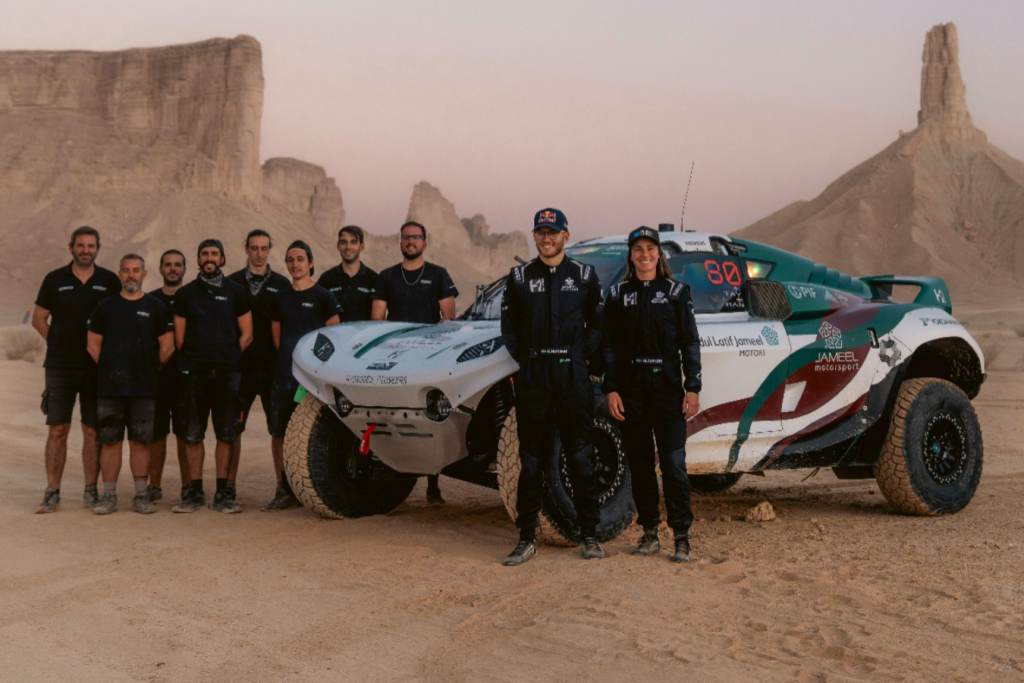
Hydrogen now finds itself at a similar point in that journey.
Much of the public discussion surrounding hydrogen-powered vehicles centres on questions of viability. Is it safe? Is it practical? Can it survive the abuse expected of a modern vehicle? These questions are not answered through theoretical modelling alone. They require engineers to build systems capable of enduring the unpredictable realities of operation, and few environments expose engineering decisions more ruthlessly than competitive motorsport.
Few people are better positioned to discuss that process than Molly Taylor.
As Australia’s first female Australian Rally Champion, the youngest winner of the Australian Rally Championship at the time, a two-time Dakar finisher, 2021 Extreme E Champion and the winner of the inaugural FIA Extreme H World Cup, Taylor has spent much of her career adapting to vehicles at the forefront of technological change. Rather than simply driving them quickly, she has worked alongside engineers to understand how those machines behave, how they evolve and how seemingly small engineering decisions shape the experience behind the wheel.
Speaking with Taylor, one theme emerged repeatedly. The arrival of hydrogen has certainly changed the race car, but not necessarily in the ways most people imagine.
“I think people expect it to feel like a completely different car,” she explains. “But the motors themselves are actually quite similar. The biggest differences come from everything that’s been engineered around the hydrogen system.”
That observation immediately reframes the discussion. The headline technology may be the hydrogen fuel cell, but the engineering story extends well beyond the power source itself.
Replacing a battery-electric system with hydrogen does not simply involve swapping one energy source for another. The fuel storage system introduces new structural requirements. Additional protection is required around the tanks. Reinforcement influences packaging. Packaging affects vehicle mass. Increased mass changes braking behaviour, weight transfer and suspension loading. Those changes then influence steering feel, tyre behaviour and ultimately driver confidence.
What appears to be a single technological decision quickly becomes an exercise in systems engineering.
It is perhaps one of the least appreciated aspects of engineering outside the profession. Public conversations often isolate technology into individual components—a better battery, a more efficient motor, a stronger material—as though improvements occur independently. Engineers rarely have that luxury. Every modification creates consequences elsewhere in the system, forcing a continual process of balancing competing priorities.
Taylor sees that process from the driver’s seat.
“The car is definitely heavier,” she says. “You notice that under braking straight away.”
Stopping additional mass is only the beginning of the story. In off-road competition, where braking zones are constantly changing and grip evolves with every passing vehicle, that extra weight influences almost every dynamic characteristic of the car. More momentum must be managed before corner entry. Suspension components experience different loading. Weight transfer becomes more pronounced. Drivers adapt their timing accordingly.
Yet, despite those compromises, Taylor speaks positively about the vehicle’s handling.
“The suspension package is much better. The car feels really capable.”
That statement might appear contradictory until viewed through an engineering lens.
The additional mass introduced by the hydrogen system has not simply been accepted as a disadvantage. Engineers have responded by redesigning the surrounding vehicle. Chassis dimensions, suspension geometry and tuning capability have all evolved to produce a platform that, while heavier, offers drivers greater confidence and flexibility through corners. The engineering objective was never to eliminate compromise entirely. It was to ensure the overall package remained capable despite the new constraints imposed by the technology.
Motorsport repeatedly demonstrates that engineering is rarely the pursuit of perfection. It is the pursuit of balance.
The conversation naturally turns from the vehicle itself to the experience of driving it, and here Taylor offers another perspective that challenges common assumptions. For generations of racing drivers, combustion engines have provided a continuous stream of information. Gear changes, engine speed and exhaust note become reference points almost without conscious thought, allowing drivers to judge grip, acceleration and wheel speed through sound as much as through feel.
Electric drivetrains change that relationship.
“You stop listening to the engine,” Taylor says. “You start paying much more attention to what the chassis is doing.”
Rather than removing information, the quieter drivetrain shifts attention elsewhere. Steering loads become more noticeable. Small changes in vehicle attitude communicate more clearly through the seat. Braking zones become richer sources of feedback. Drivers develop an entirely different vocabulary for understanding the behaviour of the vehicle beneath them.
That adaptation becomes particularly important in off-road competition, where consistency is almost non-existent.
Unlike a sealed racing circuit, every stage evolves continuously. Dust settles differently, softer surfaces develop ruts, heavier vehicles alter the racing line and grip levels can change dramatically within a single corner. Learning the circuit is only part of the challenge. Drivers must also learn how the circuit is changing beneath them.
Taylor describes this process less as relearning racecraft than recalibrating perception.
Once those new reference points become familiar, they simply replace the old ones. The absence of engine noise no longer feels unusual because the driver has begun listening elsewhere.
The same theme of preparation over reaction appears when discussing energy management.
Electrified racing often creates the impression that drivers spend entire events managing energy usage, carefully balancing performance against battery life. Extreme H, Taylor explains, is rather different.
Because the races themselves are comparatively short, much of the strategic work is completed before the car ever reaches the start line. Engineers consider ambient temperature, cooling requirements, charging strategy and environmental conditions before selecting the power maps that will be used throughout the event.
“The work is really done beforehand,” Taylor explains. “Once you’re in the car, you’re driving flat out.”
It is another reminder that successful engineering is frequently invisible. Spectators naturally focus on what unfolds during competition, yet many of the decisions determining performance were made hours earlier by engineers analysing data, modelling operating conditions and selecting the configuration most likely to succeed.
That relationship between preparation and performance extends well beyond motorsport. Engineers across every discipline understand that reliability rarely appears by accident. It is designed long before the system is asked to perform.
The same philosophy becomes evident when discussing one of the most valuable resources available to any engineering team: driver feedback.
Telemetry has transformed modern motorsport. Every lap generates enormous quantities of information describing steering inputs, brake pressures, throttle position, suspension travel, wheel speeds and countless other parameters. Yet despite this abundance of data, Taylor remains convinced that numbers alone cannot fully describe vehicle behaviour.
“Data tells you a lot,” she says, “but it doesn’t tell you exactly what the driver is feeling.”
That observation captures one of the enduring realities of engineering. Instruments measure behaviour. People experience it. The challenge lies in translating one into the other.
A driver might describe uncertainty during corner entry, reduced confidence over a crest or subtle changes in rear grip as fuel loads decrease. Those sensations are subjective, yet they often provide the clues engineers need to interpret objective data correctly. Telemetry may reveal suspension movement or brake pressure changes, but without understanding what the driver experienced at precisely that moment, the significance of those measurements can remain unclear.
The conversation between driver and engineer therefore becomes one of interpretation rather than instruction. Neither replaces the other. Instead, they combine different forms of evidence to understand the behaviour of an increasingly complex machine.



Blossom Fernandez is an automotive engineer specialising in electric vehicle systems and standards. She contributes to EV standards committees and supports emerging engineers through mentoring and STEM engagement. Blossom is a relentless learner committed to growth, challenge, and constant evolution.