

Why workshop, track, and team culture starts with language
Workshops are rarely quiet.

Compressors cycle in the background. Impact guns punctuate conversation. Radios compete with reversing alarms while several jobs progress simultaneously, each with its own priorities, interruptions and deadlines. Yet amid the movement, another system is operating almost unnoticed. It has no service interval, no calibration procedure and no part number, but it is present in every diagnosis, every handover and every decision made under pressure.
It is language.
Not the language of policies, toolbox presentations or induction manuals, but the ordinary exchanges that allow work to move. A technician questioning a measurement before a component is reassembled. A spotter calling for a pause before a vehicle is lowered. A crew member asking for clarification over the radio because something doesn’t sound quite right. These interactions are so routine that they rarely attract attention, yet they shape the way information moves through a team.
We tend to notice communication only when it fails. Instructions become assumptions. Questions go unasked. Someone hesitates before speaking, or decides that saying nothing carries less risk than interrupting the work. The visible consequence may be a mistake, a near miss or unnecessary rework, but the failure often began much earlier, in a conversation that never quite happened.
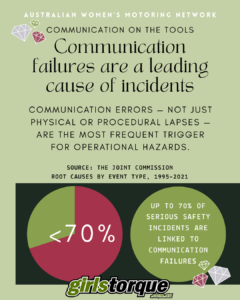
Technical industries rightly invest enormous effort in controlling physical risk. Guards, isolation procedures, torque specifications, permits, personal protective equipment and compliance systems all exist for good reason. They save lives. What receives far less attention is the communication that allows those controls to function as intended. Procedures are only effective if concerns are raised, uncertainties are voiced and critical information is exchanged before the work continues.
Perhaps that is why the highest-performing technical teams often sound remarkably similar. Whether in a workshop, a pit lane or a control room, their conversations are rarely theatrical. They are precise. Information is shared with enough clarity that the next person can make a good decision. Over time, that shared vocabulary becomes more than a means of communication. It becomes part of the infrastructure of the work itself.
Spend enough time in a workshop and you begin to notice that technical language serves a purpose beyond describing the work. It also reveals how people think about it.
A technician might point towards a component and say, “That’s broken” or words to that effect. In many situations, that is enough to start a conversation. As the diagnosis progresses, however, the language usually becomes more precise. A cracked housing becomes a fatigue fracture. Excessive movement becomes radial play. An intermittent fault becomes repeatable under load. Each refinement reduces ambiguity, allowing the next person to understand not only what has been observed, but why it matters.
That progression is more than professional habit. It is how technical teams transfer understanding.
Precision allows complex work to move between people without losing meaning. Shared terminology does not exist to sound impressive; it exists to make knowledge transferable.
Like any other technical skill, that fluency is learned rather than inherited. Drivers do not arrive at a circuit already knowing every braking marker, nor do apprentices enter a workshop speaking the language of diagnostics. Vocabulary is acquired through repetition, correction and experience. Over time, terms that once required conscious thought become instinctive, allowing attention to remain on the work rather than the words themselves.
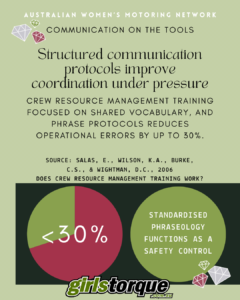
Technical work rarely depends on a single conversation. It depends on hundreds of small exchanges that occur throughout the day, most of them so ordinary they pass unnoticed. Information is handed from one technician to another. A concern is raised before a vehicle leaves the hoist. Someone asks for a second opinion before proceeding. Individually these interactions appear insignificant. Collectively, they determine how effectively information moves through a team.
This is how culture is built. Not through mission statements or toolbox slogans, but through the behaviours that become routine under pressure. In technical environments, many of those behaviours are linguistic.
Listen to a well-functioning workshop and certain patterns begin to emerge. People establish the situation before discussing solutions. Questions seek clarification rather than confirmation. Uncertainty is acknowledged early, before assumptions become expensive. A simple “What are you seeing?” often produces far more useful information than “What’s wrong?” because it encourages observation before conclusion.
Timing matters as much as wording. Experienced technicians rarely interrupt a critical task to make a point that can wait thirty seconds. Equally, they recognise when hesitation carries greater risk than speaking immediately. Knowing when to ask, when to pause and when to challenge is not simply a matter of interpersonal style. It is part of the discipline of working safely and accurately with other people.
None of these habits remove pressure. They make pressure easier to work within. By reducing ambiguity before it becomes misunderstanding, they preserve attention for the task itself rather than the personalities involved.

When these communication habits are absent, people adapt.
The adaptation is rarely deliberate. It develops gradually, through hundreds of small interactions that teach people which behaviours are rewarded, which are ignored, and which carry an unnecessary personal cost. Over time, the work begins to change, not because the technical standards have shifted, but because the flow of information has.
Some people stop asking questions because previous questions were met with frustration rather than curiosity. Others stop volunteering ideas after discovering that contribution attracts scrutiny without influencing the outcome. Some wait to be instructed, having learned that initiative is more likely to be criticised than supported. Others begin mirroring the dominant communication style because it appears to be the quickest path to authority.
None of these responses necessarily reflect disengagement. They are often rational adaptations to the environment. Individually, they make sense. Collectively, they reduce the amount of information available to the team.
Pressure exposes these patterns rather than creating them. Under stress, communication often becomes more absolute. Questions become instructions. Observations become accusations. Responsibility narrows until attention shifts from solving the problem to identifying who owns it. In that environment, people naturally devote more energy to managing consequences than sharing information.
The most effective technical teams do not eliminate urgency. They prevent urgency from becoming the dominant feature of every conversation. By keeping discussions anchored to observations, evidence and the task itself, they preserve the one resource that pressure so often erodes: the willingness of people to contribute what they know.

The most effective teams do not waste time debating personalities or assigning blame while the work is still unfolding. Information is exchanged in a way that allows the next decision to be made. Observations remain separate from assumptions. Conditions are described before conclusions are drawn. The conversation stays anchored to the work.
This does not make those environments free from conflict. Technical work is full of disagreement. Measurements differ. Diagnoses are challenged. Priorities compete. The distinction is that disagreement remains attached to the task rather than the people performing it.
Once communication shifts away from observations and towards individuals, something else begins to compete for attention. A raised voice, an abrupt instruction or a dismissive response can change the meaning of otherwise accurate information. The technical problem has not changed, yet people begin responding to the perceived threat instead of the issue itself.
High-performing teams appear to understand this instinctively. Their communication tends to be brief, precise and repeatable, not because they are consciously managing tone, but because unnecessary ambiguity consumes time and cognitive effort. The objective is not to avoid difficult conversations. It is to ensure that difficult conversations continue to produce useful information.
This also explains why conflict in technical environments is so often misunderstood. Disagreement over the work is both expected and necessary. It is how assumptions are tested and better decisions emerge. Far more damaging is conflict that develops around the delivery of information itself, where attention shifts from evaluating evidence to interpreting intent.
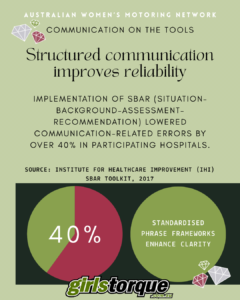
Communication rarely breaks down all at once. More often, it begins with small interruptions to the flow of information. A question is answered dismissively. An observation is met with sarcasm. Someone is interrupted often enough that they begin waiting for an invitation to speak. Individually these moments seem insignificant. Repeated over months or years, they become part of the culture.
One of the earliest signs is not conflict, but selective participation. Teams become quieter, not because people have stopped thinking, but because they have become more selective about when it is worth contributing. Information is filtered before it is spoken. Questions are rehearsed internally before they are asked. Silence begins to represent calculation rather than agreement.
These shifts rarely require formal intervention in the beginning. They are often corrected through everyday leadership: clarifying intent before assumptions take hold, redirecting conversations back to the work, or recognising when delivery has become more disruptive than the message itself. Small adjustments, repeated consistently, can prevent unhelpful habits from becoming accepted practice.
Authority within a workshop is not determined solely by qualifications, experience or organisational charts. It is also shaped by informal norms: who is interrupted, whose ideas receive immediate consideration, whose uncertainty is treated as part of learning, and whose confidence is interpreted as competence. These patterns are rarely written down, yet they influence how information moves through the team.
Women often make those informal norms more visible, not because they change them, but because they are more likely to encounter them without the benefit of long-established assumptions. A technically accurate observation that surprises the group says as much about the expectations of the listeners as it does about the speaker. Comments such as, “I didn’t expect that,” are revealing for precisely this reason. The surprise is not evidence that competence has appeared unexpectedly; it is evidence that competence had not been anticipated.
Seen in that context, the conversation is no longer about women changing workshop culture. It is about communication systems revealing where authority has become attached to assumption rather than evidence.
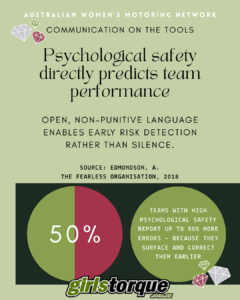
Technical fluency develops through participation. Like diagnostics, machining or welding, it improves through repeated opportunities to observe, contribute, receive feedback and refine judgement. If those opportunities are distributed unevenly, differences in confidence and communication should not be surprising. They are, at least in part, a reflection of who has been given the opportunity to practise.
Women are often perceived as changing communication norms simply by being present, when their presence may instead expose norms that have long gone unquestioned. Expectations that once seemed ordinary become visible when viewed through the experience of someone who has not been socialised into them.
The same misunderstanding often appears in discussions about professionalism. There can be an assumption that communication must somehow be constrained because women are present, as though professional language is an accommodation rather than the standard expected of any effective technical team. Yet the communication habits associated with high-performing environments—clarity, precision, respect and task focus—exist to improve the work, not to satisfy any particular group of people.
Once communication is understood as infrastructure rather than personality, authority also begins to look different. It becomes less dependent on confidence, familiarity or volume, and more closely associated with the consistent movement of useful information through the team.
Research suggests that identical communication is not always interpreted identically. Women are more likely to experience backlash for direct or corrective language, particularly where assertiveness is perceived as challenging established status rather than contributing technical information. The result is a predictable adaptation. Many women begin investing additional effort in managing how information is received before they can focus on the information itself.
That adaptation is understandable, but it carries a cost. Cognitive effort that could be directed towards diagnosis, planning or problem-solving is instead spent anticipating reactions. The question is not whether individuals should become more confident communicators. It is whether the communication system gives technically capable people enough opportunity to develop, practise and contribute their expertise.
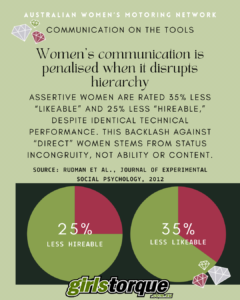
There is another consequence to communication systems that impose a high cost for speaking. People begin investing increasing amounts of effort in managing how information will be received, rather than communicating the information itself.
Research suggests this adaptation is particularly common for women in technical environments, who are more likely to experience negative responses to identical levels of directness. Over time, many become adept at anticipating reactions, softening language, or carefully managing delivery before offering a technical opinion. The adaptation is understandable. It is also cognitively expensive.
Facts-first communication offers a different approach. Rather than centring the discussion on personalities, intentions or authority, it returns attention to evidence. Conditions replace character. Deviations replace mistakes. Risk replaces blame. Standards replace opinion.
The distinction is subtle, yet important. Saying, “This won’t work,” invites interpretation about intent, confidence or authority. Saying, “This deviates from procedure and increases the likelihood of rework,” redirects the conversation towards evidence that can be examined, challenged or confirmed.
This is not simply a matter of politeness. It is a way of reducing unnecessary cognitive load. When information is presented in operational terms, teams spend less time interpreting motives and more time evaluating the work itself. The conversation becomes easier to participate in because it asks people to respond to observable conditions rather than perceived personal criticism.
In many respects, this is what effective technical communication has always sought to achieve. It separates the person from the problem, allowing disagreement to strengthen the work without unnecessarily damaging the relationships required to complete it.
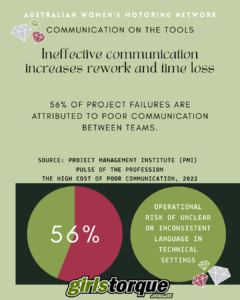
When communication is anchored to observations, evidence and agreed standards, authority no longer depends on who speaks the loudest. It depends on the quality of the information being shared. The discussion shifts away from personalities and back towards the work itself.
In environments where this approach becomes routine, direct communication is rarely controversial because it is understood as part of the technical process. Where it is absent, however, the same words are more likely to be interpreted through hierarchy, personality or status before they are considered on their technical merit. The question is no longer whether someone communicated clearly. It is whether the system was prepared to receive the information.
This is why communication deserves to be viewed as infrastructure rather than interpersonal style.
Technical organisations devote enormous effort to designing systems that prevent physical failure. Components are specified. Procedures are documented. Controls are introduced long before something goes wrong. Communication deserves the same level of attention.
When information becomes expensive to share, predictable adaptations follow. Questions remain unasked. Small concerns go unspoken. Workarounds replace correction. The absence of reported problems can begin to resemble stability, when it may instead indicate that people have quietly concluded speaking is no longer worth the effort.
For organisations that rely on complex technical work, this has consequences far beyond workplace harmony. Respect is not simply about courtesy. It is one of the conditions that allows accurate information to move quickly enough to influence decisions. Protecting respectful communication therefore protects visibility—of emerging risk, incomplete understanding, and opportunities to improve the work before small issues become larger ones.
The strongest communication cultures are rarely accidental. Like any other engineering control, they are designed, practised and reinforced until they become ordinary. They reduce the cost of contributing information, increase the number of people willing to contribute it, and allow capability to be distributed across the team rather than concentrated in a handful of voices.
Like any other aspect of technical work, communication improves when it is designed deliberately rather than left to chance. Shared terminology is introduced early. Briefings establish a common language before pressure arrives. Experienced people model the same behaviours they expect from others, reinforcing them through everyday practice rather than statements of intent.
This shifts the burden away from individuals constantly adapting to their environment and towards creating an environment that supports good decisions. The objective is not to produce more agreeable conversations. It is to reduce the cognitive effort required to move accurate information through a team, particularly when time is limited and the consequences of misunderstanding are high.
Workshops, pit lanes and technical teams rarely fail because people stop caring about the work. More often, they fail because the systems surrounding the work make it increasingly difficult for people to contribute what they know. Information is delayed, filtered or withheld, not through malice, but because the cost of speaking gradually becomes greater than the perceived benefit.
Perhaps that is why language deserves to be considered alongside every other engineering control. It is present in every diagnosis, every handover, every briefing and every decision made under pressure. When designed deliberately, it reduces ambiguity, preserves capability and allows expertise to be shared rather than concentrated. Left to evolve unchecked, it becomes another source of risk hidden in plain sight.
The tools matter. Training matters. Procedures matter.
Yet none of them can compensate for a system that discourages the free movement of accurate information.
In the end, communication is not simply the way work is discussed.
It is one of the ways good work becomes possible.
Sources:

Rudman, L. A., Moss-Racusin, C. A., Glick, P., & Phelan, J. E. Status Incongruity and Backlash Effects: Defending the Gender Hierarchy Motivates Prejudice Against Female Leaders. Journal of Experimental Social Psychology, 2012

Lerchenmueller, M. J., & Sorenson, O. The Gender Gap in Early Career Transitions in the Life Sciences. Proceedings of the National Academy of Sciences, 2018

American Philosophical Association. Tone Policing and the Assertion of Authority. APA Blog (Professional Analysis Series), 2022

Vandello, J. A., Bosson, J. K., Cohen, D., Burnaford, R. M., & Weaver, J. R. Precarious Manhood. Journal of Personality and Social Psychology, 2008

Vandello, J. A., & Bosson, J. K. Hard Won and Easily Lost: A Review and Synthesis of Theory and Research on Precarious Manhood. Psychology of Men & Masculinity (APA), 2013

Theus, D. The Leadership Load: When Emotional Labor Becomes a Second Job. Forbes / LinkedIn Thought Leadership, 2019

Baldwin, S. PhD. Do Women Have to Act Like Men to Get Ahead? LinkedIn Publishing / Organisational Psychology Commentary, 2020

International Organization for Standardization. ISO 45003: Psychological Health and Safety at Work — Guidelines for Managing Psychosocial Risks. ISO, 2021.

Guidelines on Mental Health at Work. World Health Organization, 2022.

Edmondson, A. The Fearless Organization: Creating Psychological Safety in the Workplace for Learning, Innovation, and Growth. Wiley, 2018.

BMJ Leader Editorial Team. Psychological Safety and Incident Reporting Systems. BMJ Leader (British Medical Journal), 2021.

British Psychological Society. Stress, Cognitive Load, and Effective Communication at Work. British Psychological Society, 2020.

Salas, E., Wilson, K. A., Burke, C. S., & Wightman, D. C. Does Crew Resource Management Training Work? An Update, an Extension, and Some Critical Needs. Human Factors: The Journal of the Human Factors and Ergonomics Society, 2006.

Institute for Healthcare Improvement. SBAR Toolkit: Situation–Background–Assessment–Recommendation. IHI, 2017.

Eagly, A. H., & Karau, S. J. Role Congruity Theory of Prejudice Toward Female Leaders. Psychological Review (American Psychological Association), 2002.

American Philosophical Association. Tone Policing and the Assertion of Authority. APA Blog – Professional Analysis Series, 2022.

de Botton, A. Status Anxiety. Penguin, 2004.

British Psychological Society. Status, Threat, and Behaviour Under Pressure. British Psychological Society, 2019.

Model Code of Practice: How to Manage Work Health and Safety Risks. Safe Work Australia, 2018.

Bridget Bell is a seasoned motorsport media professional and a skilled mechanic, with over a decade of experience in On-Air Hosting, Event Hosting, Television Presenting and Commentating. Passionate about supporting women in both the industry and motorsport, Bridget volunteers as a mentor and actively champions female representation.
Disclaimer: While due research has been conducted, the views expressed in our articles are those of the author and may not necessarily reflect everyone’s views. If you notice an error, please email quoting the blog article title and an explanation of the error.