

Where It Clicks
There’s a moment in engineering where the numbers stop being abstract.
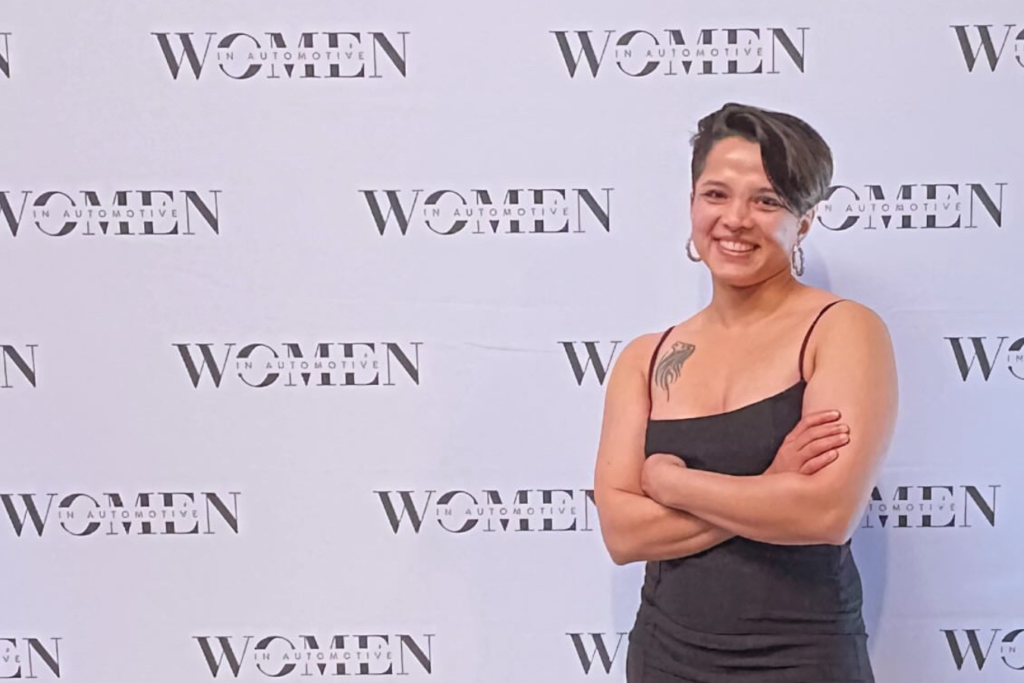
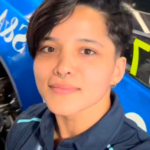
For Blossom Fernandez, it arrived trackside — not in a lecture theatre, not behind a screen, but in the controlled chaos of vehicle evaluation testing. Calculations, simulations, driver feedback — all of it converging into something tangible, measurable, undeniable. The car behaved exactly as the data said it would. The gap between theory and reality collapsed.
Her brain, as she puts it, “was basically setting off fireworks.”
It’s a moment many engineers spend years chasing. For Fernandez, it became the foundation of how she thinks — and where she does her best work: where theory meets something you can actually see, hear, and feel.
The path there wasn’t linear.
Her early ambition pointed skyward — a fighter jet pilot — before practical constraints redirected her toward engineering. It was a shift that might have felt like compromise at the time, but curiosity had already begun to take hold elsewhere. Riding her Thunderbird 500cc motorcycle, she found herself increasingly drawn not just to the experience, but to the mechanics beneath it.
What started as appreciation became interrogation.
How does this actually work?
University gave her the language, but not yet the instinct. Like many early-career engineers, she could follow the equations — but applying them to something real didn’t properly click until later.
“The equations made sense on paper, but applying them to real problems didn’t properly click.”
It wasn’t until her second role, where things were breaking in real time and needed fixing, that the connection locked in.
Things either worked, or they didn’t.
And if they didn’t, you had to figure out why — quickly.
Motorsport entered the picture not as spectacle, but as proximity.
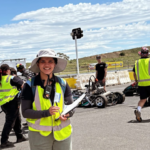
Volunteering as a scrutineer and later serving as a dynamics event captain at Formula SAE gave Fernandez a vantage point few spectators experience. It wasn’t about watching anymore — it was about understanding what actually makes a car pass or fail.
That shift — from observer to participant — clarified something more permanent. Motorsport wasn’t just interesting. It was somewhere she wanted to be.
Not adjacent to it. Inside it.
Today, as an Electric Vehicle Engineer at GB Auto, her work reflects that same proximity to complexity.
No two days look alike — which in practice means switching between very different problems, quickly.
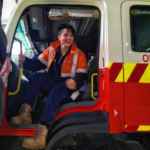
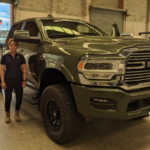
Her role spans electric vehicle programs and mining-sector applications, often simultaneously. One day might involve diagnosing why a system isn’t communicating properly on an EV; the next could be designing a wiring harness, writing software requirements, or working alongside evaluation engineers at a test ground.
Beyond that, her work extends into fleet-focused mining projects — environments where failure isn’t an inconvenience, it’s a shutdown. Systems have to work, consistently, under load, and be provable on paper afterwards.
The common thread is integration.
In practice, that might mean fixing why a system isn’t talking properly one day, and redesigning how it connects the next. It’s less about working in one lane, and more about understanding how everything interacts — electrical, mechanical, software — and where it breaks down.
Her approach to problem-solving reflects that same structure.
It doesn’t begin with trial and error. It begins with clarity.
What is the system supposed to do?
What does success actually look like?
What assumptions have we made — and have we checked them?
Only once those fundamentals are clear does she move forward.
If the result doesn’t match the expectation, she doesn’t keep pushing — she steps back. Rechecks the basics. Walks through the system from start to finish until the point of failure is obvious.
“Often, revisiting the fundamentals reveals a missed condition, incorrect assumption, or overcomplication.”
From there, the fix isn’t guesswork. It’s targeted.
It’s a method that balances instinct with discipline — because curiosity, left unchecked, can send you down every possible path except the right one.
Early on, Fernandez describes throwing everything at a problem or disappearing down a rabbit hole trying to understand everything at once. Over time, she’s learned to track changes, separate signal from noise, and decide when going deeper is actually useful — and when it isn’t.
Because in real-world engineering, time, cost, and constraints are always part of the system too.
The most significant shift in her thinking, however, didn’t come from a system.
It came from people.
Participation in the Women in Mining mentorship program introduced a different layer to problem-solving — one that couldn’t be mapped out in diagrams. Her mentor, Alan, didn’t give answers. He asked questions. The kind that force you to stop, think, and actually work out what’s going on.
“I realised I wasn’t stuck because I lacked ability, but because I’d lost clarity and direction.”
More importantly, she began to recognise that technical problems rarely sit on their own. They sit inside teams, timelines, expectations, and communication gaps.
Ignore that, and even good engineering struggles to land.
Since then, her approach has shifted. Before jumping into a solution, she now looks at the bigger picture — why the task exists, who’s involved, and where alignment might be missing.
Because once people are aligned, the technical side usually follows a lot faster.

That shift has carried directly into how she leads.
What started with supervising an intern quickly became a test of adaptability — learning how to explain the same concept in different ways, depending on who was in front of her. That experience grew into mentoring multiple students, reinforcing a simple reality: there’s no one-size-fits-all approach.
Some people need structure. Others need space. Most need both, at different times.
The goal isn’t to give answers — it’s to help people think clearly enough to find their own.
In doing so, Fernandez has found herself on both sides of the mentorship equation — still learning, while actively guiding others. It’s a deliberate move, not just to give back, but to build the people skills that engineering eventually demands whether you plan for it or not.
The industry she’s working in is evolving just as quickly.
In the EV and automotive space, the focus is shifting toward what actually works in the real world — not just what looks good on paper. Battery durability, system reliability, and practical infrastructure are becoming just as important as performance figures.
For engineers like Fernandez, that means working across disciplines more than ever — understanding not just the component in front of you, but how it interacts with everything around it.
It’s exactly the space she’s building her capability in: systems, integration, and the gaps between them.
Constraints, however, are still part of the equation.
Visa limitations have shaped how she navigates opportunities, requiring patience and careful timing. But rather than slowing progress, it’s sharpened focus.
When that constraint lifts, the plan is simple: accelerate.
Upskill. Expand. Move forward with intent.
Looking ahead, her direction is clear — race engineering, powertrain systems, and project-level thinking.
Not just solving problems, but understanding them early, making better decisions sooner, and delivering outcomes that hold up under real-world pressure.
Motorsport remains a key part of that growth. It compresses timelines, removes excuses, and forces theory into practice — quickly.
For Fernandez, progression isn’t about titles.
It’s about capability.
Knowing more today than yesterday. Being able to step into a problem and work it through, even when it’s unfamiliar. Building both depth and flexibility, so you’re not limited to one type of work or one way of thinking.
As she puts it, it’s about upgrading your internal “RAM and ROM” — staying ready for whatever comes next.
Not perfect. Just better than yesterday.
Because in the end, engineering — like any system — doesn’t stand still.
It evolves.
And for those willing to stay in that space — where things don’t quite fit yet, where you have to think, test, and adjust — that’s where it starts to make sense.
That’s where it clicks.


What’s your why? Whether you’re a racer, behind the camera, on the tools, or the loudest cheerleader, we want to hear your story! Share with us your passion and motivation to inspire others. Submit your story: https://bit.ly/4aYoxO4