

The Underrated Superpower:
Why Women’s Adaptability Is Already High — and How to Make It Count
Adaptability is often described as a future-facing skill — something workers will need to develop to survive disruption, automation, and accelerating change. In reality, many women have been performing high-level adaptability for years, long before organisations learned how to name or reward it.
What is now labelled the Adaptability Quotient (AQ) has rarely arrived as a training opportunity for women. Instead, it has appeared as expectation: absorb change, fill gaps, manage friction, stay composed, and keep things moving. Quietly.
The problem is not that adaptability is undervalued as a skill. It is that women’s adaptability is so normalised it disappears into the background — treated as personality, goodwill, or “helping out”, rather than as strategic labour that drives outcomes.
Adaptability Is Already Being Performed — Just Not Recognised
Before adaptability became a leadership buzzword, it already had a familiar shape. It was the woman who did her job — and then organised the Christmas party, kept the kitchen functional, managed stationery, took the meeting minutes “because she has the best handwriting”, proofread the email, answered the phone, smoothed conflict, onboarded the new hire, and stayed emotionally regulated when others did not.
Research on office housework and invisible work consistently shows that women disproportionately take on planning, relationship maintenance, coordination, and emotional regulation at work. These tasks require constant micro-adjustment, rapid task switching, anticipatory thinking, and situational awareness — precisely the behaviours now described in high-AQ leadership frameworks.
Add to this the extensive body of research on gendered cognitive labour: women carry more mental load for tracking tasks, anticipating needs, and managing complexity across both home and work. This spillover drains resources and increases fatigue, yet it also demonstrates that adaptability is already being exercised continuously, often without formal authority or acknowledgement.
In other words, AQ is not a mindset gap. It is a recognition gap.
The Cost of Invisible Adaptability
When adaptability is treated as an unremarkable baseline rather than a valuable contribution, it becomes extractive.
Women are often selected — not promoted — because they are seen as safe, organised, emotionally literate, and capable of absorbing overflow without disruption. Once a woman demonstrates this capacity, she is relied upon again and again to stabilise systems that were never properly designed.
This is where adaptability quietly turns into self-censorship. Women learn to regulate tone because anger is read as hysteria. They stay professional while managing others’ emotions because composure is expected. They multitask during meetings — contributing ideas while documenting outcomes — and are remembered for the notes, not the thinking.
This is not resilience as strength. It is resilience as containment.
Critical research on resilience narratives warns that when adaptability is framed purely as an individual trait, responsibility for systemic dysfunction shifts onto workers themselves. Those who struggle are seen as lacking discipline or grit, rather than responding rationally to structural overload.
Praising women for their resilience without redistributing the load or changing the system does not empower them. It entrenches inequality.
Why Adaptability Still Matters — and Always Will
None of this means adaptability is not valuable. In fact, the opposite is true.
A substantial body of management and organisational research shows that adaptability correlates strongly with measurable business outcomes. Cultures that support adaptability report higher productivity, stronger engagement, lower turnover, smoother transitions during change, and better continuity under pressure.
Leadership research consistently links high AQ to effective disruption management, innovation, team cohesion, and risk reduction. These are not “soft” benefits — they are cost avoidance, performance stability, and strategic advantage.
The contradiction is this:
the very behaviours organisations reward in executives are the same behaviours many women perform informally every day — just without the title, authority, or pay.
The Language Gap: From “Helping” to “Strategic Adaptability”
At senior levels, adaptability is described in high-status language:
-
adaptive leadership
-
transformation capability
-
navigating uncertainty
-
recalibrating strategy mid-cycle
-
unlearning and relearning at speed
At lower levels, the same work is labelled:
-
helping out
-
being flexible
-
supporting the team
-
keeping things running
This linguistic gap matters, because organisations reward what they can name.
The work does not change. The framing does.
Reclaiming AQ as Leverage, Not Obligation
The answer is not for women to become more adaptable. Most already are.
The leverage comes from making adaptability legible — and bounded.
That means shifting from effort-based descriptions to impact-based ones. Not:
“I just step in where needed.”
But:
“I stabilise workflow during periods of change.”
“I manage transition risk and continuity.”
“I regularly integrate across roles to prevent escalation and delay.”
It means translating invisible labour into outcomes:
-
what didn’t break
-
what didn’t escalate
-
what moved faster
-
what cost less
This is not about asking louder or doing more. It is about attaching visibility and value to work that already exists.
Adaptability without boundaries leads to burnout.
Adaptability with strategy leads to authority.
Strengthening and Sustaining AQ — Without Giving More Away for Free
For many women, adaptability is not something to be learned from scratch — it is already deeply embedded through years of navigating complexity, role creep, and change. The goal is not to perform more adaptability, but to strengthen, sustain, and strategically deploy the adaptability already in use.
Evidence-based approaches to developing AQ are most effective when they are applied with boundaries, visibility, and intent — not as a quiet extension of unpaid labour.
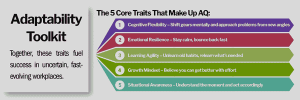
1. Train Cognitive Flexibility (Without Fragmenting Attention)
-
Mindfulness Training: Improves attentional control and reduces cognitive overload, supporting intentional task-switching rather than constant interruption.
-
Novel Learning: Learning a new language, instrument, or technical skill activates flexible thinking and reinforces neural adaptability — particularly valuable during career transitions.
-
Task-Switching Exercises: Structured cognitive tasks or simulations can build mental agility, but should complement (not replace) clear role design and workload limits.
Key distinction: cognitive flexibility is most valuable when it is chosen, not imposed through constant disruption.
2. Enhance Emotional Resilience (As Capacity, Not Containment)
-
Cognitive Behavioural Therapy (CBT): Supports reframing stressors and building coping strategies that protect long-term wellbeing.
-
Physical Wellness: Sleep, nutrition, and aerobic exercise measurably improve stress tolerance and recovery.
-
Social Support: Trusted relationships buffer against adversity and prevent isolation during high-demand periods.
Resilience should support sustainability, not justify absorbing excessive emotional labour or remaining silent under pressure.
3. Boost Learning Agility (With Visibility and Credit)
-
Simulations and Cross-Functional Roles: Exposure to uncertainty strengthens adaptive capability when learning outcomes are recognised and valued.
-
Reflection and Feedback: Structured feedback loops help translate experience into growth — particularly when adaptability is explicitly named in performance conversations.
-
Mentoring and Shadowing: Accelerates experiential learning and helps convert informal adaptability into formal development pathways.
Learning agility becomes leverage when it is documented, not just demonstrated.
4. Foster a Growth Mindset (Without Normalising Failure as a Cost of Entry)
-
Praise Process, Not Talent: Reinforces effort, learning, and problem-solving rather than fixed notions of capability.
-
Normalise Review, Not Repetition: Examining what didn’t work should lead to changed systems, not repeated personal adjustment.
-
Neuroscience-Based Training: Understanding the brain’s capacity for change supports confidence during transitions and reskilling.
Growth mindset is powerful — but it must coexist with structural accountability, not replace it.
5. Sharpen Situational Awareness (Without Carrying the Whole Room)
-
Scenario-Based Learning: Builds the ability to anticipate and respond to evolving situations.
-
Open Communication: Effective feedback loops improve team vigilance and shared responsibility.
-
Critical Incident Reviews: Structured learning from mistakes distributes insight across teams, rather than relying on one person to “just know.”
Situational awareness should inform leadership and decision-making — not quietly compensate for others’ disengagement.
Measuring AQ — For Insight, Not Self-Surveillance
While AQ does not yet have a universal scoring system, tools such as AQai, the Adaptability Quotient Scale (AQS), and the Change Style Indicator (CSI) can provide insight into adaptability patterns across ability, mindset, and environment.
Used well, these tools help:
-
name existing strengths,
-
identify sustainable development areas,
-
support evidence-based conversations about role scope, progression, and leadership readiness.
Qualitative self-reflection remains equally valuable:
-
How do you respond to unexpected change?
-
Where do you adapt by choice — and where by necessity?
-
Which adaptations lead to recognition, and which disappear?
-
What are you willing to unlearn — and what should no longer be yours to carry?
The goal is not perfection.
It is intentional growth with recognition and reward.
A Word of Caution — and a Way Forward
AQ rhetoric becomes dangerous when it is used to justify endless flexibility without structural change. Adaptability should not be a substitute for adequate staffing, clear roles, psychological safety, or accountable leadership.
If organisations want adaptability, they must resource it:
-
build it into role design
-
reward it formally
-
distribute it fairly
-
support it culturally
And if women want to leverage their adaptability, they must stop treating it as personality and start treating it as capital.
Final Thought
Women do not need to prove they are adaptable. The evidence is already there — in the invisible work, the coordination, the emotional regulation, and the constant recalibration that keeps systems functioning.
The work now is not to perform more adaptability, but to claim recognition, authority, and pay for the adaptability already being delivered.
Adaptability is not just a survival skill.
When named and leveraged, it is a negotiating position.
And it’s long past time it counted.
Sources:

AQai. Adaptability: An Organisational Superpower (2019).
https://www.successperformancesolutions.com/wp-content/uploads/2020/12/AQai-2019-Report-Adaptability-an-organizational-superpower.pdf

AQai. The AQ Model.
https://www.aqai.io/resources/the-aq-model-old

Sevak, A. (2025). Adaptability Quotient: The Defining Skill of the Future. LinkedIn.
https://www.linkedin.com/pulse/adaptability-defining-skill-2025-amit-sevak-ogmre

Zbfoe, G. (2024). Adaptability Quotient: A New Dimension of Leadership. LinkedIn.
https://www.linkedin.com/pulse/adaptability-quotient-aq-new-dimension-leadership-gerd-zbfoe

OKR International. Adaptability & OKRs: Driving Strategy Execution.
https://okrinternational.com/adaptability-and-okrs-how-the-adaptability-quotient-drives-global-strategy-execution-success/

Synergogy. Adaptability Quotient Assessment Overview.
https://synergogy.com/synergogy-assessments/adaptability-quotient/

Texila Journal of Management. Impact of Adaptability on Job Performance.
https://www.texilajournal.com/thumbs/article/Management_Vol11_Issue2_Article_24.pdf

McKinsey & Company. Developing a Resilient, Adaptable Workforce.
https://www.mckinsey.com/capabilities/people-and-organizational-performance/our-insights/developing-a-resilient-adaptable-workforce-for-an-uncertain-future

HCAMag Australia. Adaptability Quotient: A Game Changer for Organisational Success.
https://www.hcamag.com/au/specialisation/leadership/adaptability-quotient-the-game-changer-for-organisational-success/500320

Vorecol. Adaptability, Engagement and Organisational Growth.
https://vorecol.com/blogs/blog-what-role-does-adaptability-play-in-employee-success-and-organizational-growth-159128

PeopleThriver. Link Between Engagement and Business Performance.
https://peoplethriver.com/what-is-the-link-between-employee-engagement-and-business-performance/

Niche Academy. Resilience and Adaptability: How You Lead Matters.
https://www.nicheacademy.com/blog/resilience-and-adaptability-how-you-lead-matters

https://www.bbc.com/worklife/article/20240313-invisible-emotional-labour-women-in-workplace

Allen, T. et al. (2023). Invisible Work and Gender Inequality. Gender & Society.
https://journals.sagepub.com/doi/10.1177/08912432221128544

National Institutes of Health (NIH). Gendered Cognitive Labour and Mental Load.
https://pmc.ncbi.nlm.nih.gov/articles/PMC12058002/

Center for Focused Therapy. Invisible Labour, Visible Consequences.
https://www.centerfocusedtherapy.com/post/invisible-labor-visible-consequences

Hirsch et al. (2021). Task Switching, Gender, and Cognitive Load. PubMed.
https://pubmed.ncbi.nlm.nih.gov/32933422/

OECD. Cognitive Flexibility as a Core Skill.
https://www.oecd.org/content/dam/oecd/en/topics/policy-issues/future-of-education-and-skills/learning-compass-constructs/CognitiveFlexibility.pdf

NIH. Critique of Resilience Discourses and Neoliberal Labour Expectations.
https://pmc.ncbi.nlm.nih.gov/articles/PMC11971725/

NIH. Psychological Costs of Individualised Adaptability Narratives.
https://pmc.ncbi.nlm.nih.gov/articles/PMC9932877/

Tandfonline (2024). Resilience, Gender, and Structural Inequality.
https://www.tandfonline.com/doi/full/10.1080/2331186X.2024.2439655

Motorola Solutions. Improving Situational Awareness.
https://www.motorolasolutions.com/en_xa/solutions/how-to-improve-situational-awareness.html

WalkMe. Learning Agility in the Workplace.
https://www.walkme.com/blog/learning-agility/

Practera. Learning Agility Explained.
https://practera.com/learning-agility/

Growth Engineering. Growth Mindset and Performance.
https://www.growthengineering.co.uk/growth-mindset/

PubMed. Neuroscience of Cognitive Flexibility and Learning.
https://pubmed.ncbi.nlm.nih.gov/38971431/

Bridget Bell is a seasoned motorsport media professional and a skilled mechanic, with over a decade of experience in On-Air Hosting, Event Hosting, Television Presenting and Commentating. Passionate about supporting women in both the industry and motorsport, Bridget volunteers as a mentor and actively champions female representation.
Disclaimer: While due research has been conducted, the views expressed in our articles are those of the author and may not necessarily reflect everyone’s views. If you notice an error, please email quoting the blog article title and an explanation of the error.